Johnny Gordines: A Farmer Caught in the Crossfire

Screenshot 2014-01-15 21.43.03

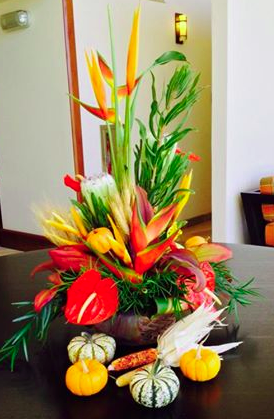
When most people think of Hawaii, they have the image of beauty.  Beauty of the mountains, the white sandy beaches and bright blue oceans and also the natural fauna of our islands.   The florals of our islands are truly unique and has become a synonymous with what we think of Hawaii.   We are so lucky to have many small farmers who make up the Hawaii floriculture industry.  Many of them have been at their work for a long time sending that bit of aloha around the world.  One of those farms is run by Johnny and Terry Gordines, who owns Tropical Flowers Express on Kauai.

When the issue of Bill 2491 hit the island of Kauai last year, some farmers, who know the agriculture issues in Hawaii, spoke out.  Johnny was one of them.  Others stood in the background instead of taking the risk of being a target.  Little did he know that he was not dealing with local folks, and was barraged with disrespect and hate for submitting testimony for the bill and for a letter in The Garden Island paper.

Here’s his testimony that he sent it which was publicly filed and viewable to all.

July 26, 2013


To Kauai County Council members:


It would be wonderful if farmers could stand in their fields, wave their arms and weeds, insects and plant diseases would magically disappear. It is too bad this cannot happen.


Instead, to banish pests and disease, farmers rely on sound scientific practices. They use pesticides and seeds resistant to insects and diseases. Their crops thrive and people all over enjoy a bounty of healthful fruits and vegetables and beautiful flowers.


Farmers use pesticides with great care and regard for themselves, their families, the people who work in their fields and their neighboring communities. Authorities in the State of Hawai’i and the U.S. government monitor farmers and all of the work that goes into pesticide development and application.


With its Bill 2491, the Kaua’i County Council seeks to insert itself into regulating pesticides and GMO crops — the exact same things our state and federal governments are already doing. It would take years and untold millions of dollars for our county to develop the same expertise and professional staffing to do what Hawai’i and the federal government are already doing.


The bill will impose many of these costs on the commercial seed growers in Kaua’i. Faced with these new costs, the growers will probably close down their farms, layoff their workers and leave Kaua’i.  It has been stated by Mr. Gary Hooser, the introducer of the Bill 2491, that it will not affect the small farmers here on Kauai.  On the contrary, if the seed companies are forced out of business, the chemical supply companies here on Kauai (Crop Production Services and C.Brewer Chemical Co.) will be forced to go out of business. This scenario will be devastating to the farmers on Kauai. We presently purchase chemicals, soil amendments, irrigation supplies as well as organic materials from them!  This will have a major impact on my business Tropical Flowers Express. Please consider the impact on the Kauai farmers.


I do know that, as the former farm manager for the Kauai Ag Research Center operated by the University of Hawai’i, College of Tropical Agriculture, this bill would devastate our work. I have applied restricted use (RUP) and general use pesticides in my work at the University for the past 32 years and have been a certified Category 10 licensed applicator. Our employer has provided physical exams yearly as well as a cholinesterase exam.  Department of Labor & Industries rule (WAC 296-307-148) requires agriculture employers to provide blood testing to workers who handle pesticides that can lower “cholinesterase” in the body. In my 32 years of service for the U.H., neither mine nor any of the employees’ level of pesticide exposure or handling, has ever been at a level that was detrimental to our general health! I am now 63 years old.


I am also the president of the Hawaii Tropical Flowers and Foliage Association on Kauai and a Director for Kauai on the Hawaii Floriculture and Nursery Association our statewide umbrella organization. The Floriculture industry is a vanity industry where the newest and unique catches the attention of the market. This means for our industry to remain competitive we need to have new and cutting-edge flowers and foliage in new colors and styles. An important tool for this is to be able to get new varieties, longer lasting varieties, and healthier varieties through the use of science, technology and innovation, such as GMO.


We believe it is important to look to the future of our agricultural industry and not handicap ourselves with laws that seek to close the door on technology. It is important that we keep finding solutions to pest and diseases that currently attack our plants and crops. With disease and pest resistant plants, we would be able to use less pesticides, which would lower costs for farmers and have a greater yield of product, allowing our sector in agriculture to improve efficiencies.


Please, County Council members, before you vote on this bill consider the damage it can do to agriculture on Kaua’i — the jobs it can destroy and the businesses and communities that will suffer. Please think wisely and vote “No” on Bill 2491.


Sincerely,


Johnny Gordines

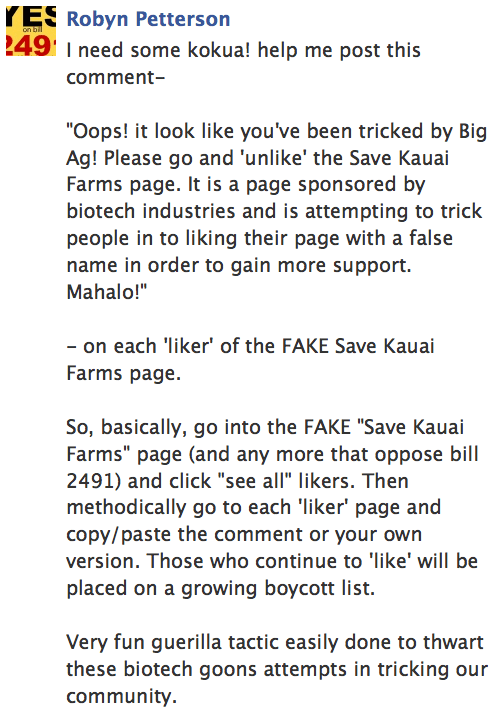
Usually in Hawaii, most people are pretty respectful of differences, however on Kauai, the story is completely different.  What happened on the social media was totally shocking to most levelheaded folks.  The anti-GMO mob decided to attack his business online through his Facebook page and his Yelp page.  Just see what this small farmer and business owner had to contend with, a bunch of bullies right in his backyard.

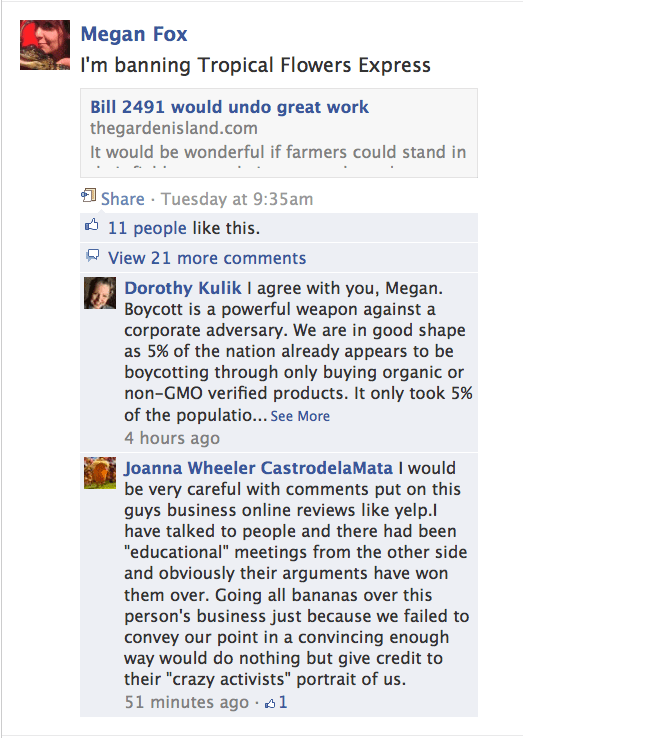
This is what was being said about his business online in public posts on Facebook after he spoke out.

Screen Shot 2013-09-10 at 8.48.09 AMScreen Shot 2013-08-11 at 3.55.25 PMmegan fox

One activist even posted this comment on his Facebook business page too.

Screenshot 2014-01-14 21.23.33

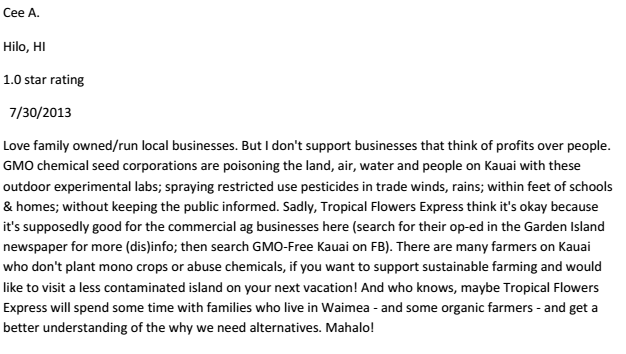
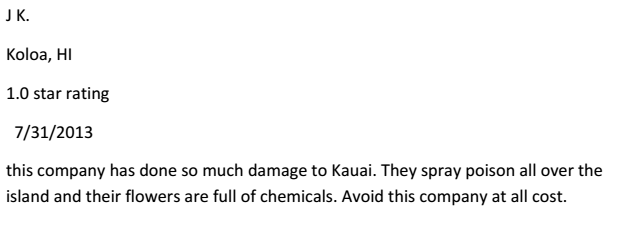
They went on Yelp too and disparaged his business.  Some review have been removed but others persist.

Screenshot 2014-01-15 22.43.01Screenshot 2014-01-15 22.43.36

You can read the corresponding reviews below to the above clip since they have since been removed.
Screenshot 2014-01-14 21.23.48Screenshot 2014-01-14 21.22.04

Screenshot 2014-01-14 21.22.35

This issue goes well beyond the corporate hate and government distrust that these activists share.  It hurts everyone in the process.  The attacking of small farmers like this, who know the technology and tools available and speak up, ultimately pay the price for doing so.  That is why so many farmers like Johnny Gordines and others look to the leaders, to address this issue first and foremost, with facts and evidence, and not the loudest voices of opinion.

Farmers keep our country country and help the spread the beauty of Hawaii around the world. The support of the legislators is crucial in perpetuating this because you can’t tear apart agriculture, because doing so hurts it as a whole.  We need leaders’ support to keep Johnny at his work to spread that bit of aloha around the world!  Support the Hawaii Right to Farm Bill and stand up for what is right!

Visit Johnny’s work at Kauaiflowers.com and on Facebook at Tropical Flowers Express.

Support the farmers with local voices!

TFE3

Hope for the Future Generation of Farmers

DSC_1711

As a kid growing up on the farm, I knew firsthand how hard farm life was. There was no leisurely Saturday mornings in front of the TV or fooling around all day doing nothing. There was work to be done before the sun even rose and time was precious. Seeing how hard my parents had to work and all the time and energy spent on the farm was not clean or easy either. Farming did not make enough money to support a family of four kids so my dad had to take on another full time job to make ends meet. If he wasn’t working at his day job, he was working on the farm. My father was always working and doing something. He still does it to this day well into his 70’s!

Having a childhood of hard work and seeing all the toils and troubles of the farm made me realize as a kid that I didn’t not want to pursue that as my life’s work. It just wasn’t worth it to put in all the hard work and get little in return for it in terms of financial compensation. My parents didn’t push us into considering farming as a career either as during the 1990s because the papaya ringspot virus was at the peak of its destruction and looking as if there was no future. It really appeared that what was once my grandfather’s farm and now my dad’s farm would be over until it was saved by the biotech research. By that time, I had already chosen a different career path into health care.

As I got older and moved off of the laborious part of the farm, I did get to see an entire different picture as to why my dad kept at it, despite all of the hardships involved. In college, I started to help out with doing the small deliveries in downtown Honolulu to the long time store keepers who sold my dad’s papayas. On one occasion, I had been running late for the delivery and found myself encountering a line of old folks waiting for me. I got scolded by them and heard old worn canes hit the concrete to show me their irritation for the delay. As soon as I opened the pick-up truck bed and struggled to bring in the cases of papayas, these old folks went back into filing into their line at the shop’s entrance. No sooner had the shopkeeper started unpacking the boxes did the flurry of white hair and scent of medicinal rubs hone in on the fruit. This was amazing to me that these old folks were so energetic about getting their fruits!

The more I did these deliveries, I realized the reason why my dad worked from the crack of dawn to dusk on the farm. He had a very faithful and grateful following of people that were seeking out his papayas! He loved hearing from these folks about how great his fruit was and how much they enjoyed it every week. Many of these customers have gone to these small stores or Times Supermarket for decades only for his fruit. To my dad, this was worth the work of farming. It isn’t only about the money he makes to keep at it, but also about the appreciation he gets from his customers that kept him farming all of these years. His customers are also grateful that they still can have this fruit regularly thanks to technology.

I now look back on all of these experiences with a completely different view of farming. My siblings and I did not immediately consider continuing this family business, but my brother has felt and heard the appreciation of our customers that won him over to follow in the footsteps of my dad. I start to look even further from brother and ask myself, “Who would be next to continue our family legacy?” It would have to be my children to step up. Will I be like my parents who discouraged us to not pursue it because of the issues and risks involved or will there be a real future for farming for my kids?

At this moment in time with all of the vitriol in Hawaii with agriculture, I am not sure if I could honestly tell my children that they should consider farming, but I just keep hoping. My 3-year-old is in total awe of her papa and going down to the farm. She loves running around in the field under the canopy of papaya trees and pulling weeds in the fields. She scales up into those old tractors and sits up high on that seat ready to start driving. Very few kids have those kinds of opportunities nowadays. I hope that I do get to tell her this one day, “Yes, Katelyn, you just might be a farmer like your papa and uncle!”

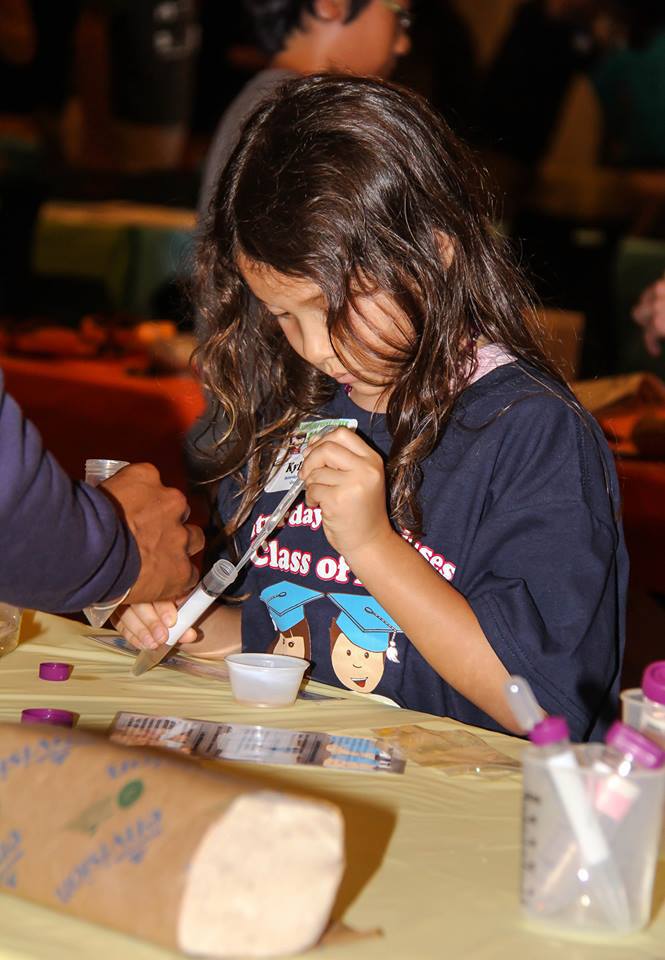
For now, I keep an open mind and provide my kids with opportunities of what the world has to offer. How the world is changing and where technology is going seems infinite and so is my hope for the future of farming, if we support and nurture it. The future lies in my older daughter who loves learning science from the UH Geneius Program and my younger one who loves playing with her tractors and trucks that she chose with her papa. They are my hopes for the future generation of farmers.

kyliescience


***News Update: Lawmakers have introduced the Hawaii Right to Farm Act to help allow farmers access to the tools available to farm.  A very huge mahalo for the introducers of this Bill to help give our farmers support: Representatives Onishi, Aquino, Awana, Bellati, Brower, Cabanilla, Cachola, Choy, Cullen, Evans, Fale, Hanohano, Hashem, Ichiyama, Ito, Kobayashi, Mizuno, Morikawa, Nakashima, Saiki, Say, Souki, Takayama, Tokioka, Tsuji, Woodson, Yamane, Yamashita, Fukumoto, Johanson, Luke, Matsumoto, McDermott, Ohno, Takumi, Ward.  Our leaders are hearing the farmers out!***

Please continue to speak up for the our farmers by signing my petition and help Maui farmers also by signing their petition.


This is a repost from my Huffington Post blog.

Caught in the Crossfire: The Small Farmers

Scan

It’s 5 am in the morning and the sun hasn’t even broken through the horizon but the papaya farmer is up already.  He gets dressed and ready to start the day to head down to the farm with his lunch packed and water bottle filled.  His body aches from the work yesterday but a little bit of muscle rub and a pain pill helps him get going and ready to toil the land again.

The farmer takes one last look at his desk before heading out to be sure of the things he has to do today.  He looks over his list to remind himself that today he has to stop by the accountant’s office to be sure to turn in his labor hours for payroll so that checks can be cut on time.  He has to make sure that all his invoices are tallied and ready to file for the general excise taxes and quarterly tax bill.  The invoice for the tractor battery that was stolen last month also have to be paid along with the utilities used.  Property taxes and leases have to be paid by the accountant.  Hopefully, there will be enough income at the end of the month to pay himself a salary also.  Once all that is settled, he heads outside to load his truck to head down to the farm.

His pickup truck is already loaded with the gas cans, fertilizer, potting mix, seeds, and other supplies needed to prep for the new planting.  The farmer did that earlier the day before and can just take a leisurely drive down to the country where his farm is at.  While driving, he gets multiple voicemails from his customers but continues on to check it later.  For some reason, it is unusual that he has gotten at least 7 calls before 7 a.m. but he reminds himself to listen to it.

When the farmer gets down to the fields, he unloads all the supplies from the truck and prepares the tractors and packing shed for today’s harvest.  It had rained the night before so the soil is really soft and moist which means that the picking will take longer than usual to get through the mud.  As he surveys his fields, he notices that his newest field looks different.  The wild pigs must have come down and dug up some of the latest seedlings and tore up the irrigation lines with it.  He makes a mental note to be sure to replace those seedlings and make the repairs after the harvest.

He stops for a moment to check all those new voicemails he received.  Apparently, the outer island’s controversial bill was passed and his customers are worried that they will be affected by it.  He reassures them but in the back of his mind, he’s troubled that there is yet more regulation to come.  He already went through an onerous regulatory process to get food safety certified that cost him a significant amount of income and time.  He also knows that he completed all of his Federal compliance documentation and is preparing for his State level regulations too.  He gets a headache just thinking that there will be yet a third level added to his plate in the future.  That thought goes to the back of his mind as he reassures his customers that they will still have their papayas.  Those conversations leave him very troubled for the future viability of the farm but he has work to do.

It is now time to harvest the field under the ominous cloudy skies that hang overhead.  He jumps on his forklift with its platform and bins preloaded to pick this week’s fruit.  The workers are quick to notice that the harvest looks suspiciously low in the new field.  Upon closer inspection, they notice that there is sap dripping from the stems of the trees.  They all realize that someone has beat them to the fruit already.  The farmer climbs down the forklift and scans the field.  It looks as if some 500 lbs. of fruit have been stolen this morning.  He gets back up the seat and continues to pick whatever remaining fruit is left.  It’s a devastating harvest of half of the usual amount.  That’s not a good thing because his customers were expecting full orders to be filled and he won’t be able to supply it.

After about 3 hours, the entire field is picked of whatever fruit is left and brought to the processing shed.  There the farmer and his workers grade, wash, then pack the fruits up for delivery tomorrow.  The papaya cases are packed in to the refrigerator to keep it fresh for tomorrow’s delivery.  The day is not done yet since there is still more work ahead.

The farmer does a check of his equipment to be sure that it is all in working order to get another field ready for a new planting.  The cover crop is matured and ready to be plowed back into the soil.  His plow is hooked up and the gas tank is filled in the tractor.  Everything looks like it is in working order and good to go.

He then checks his other tractor that will be used to spray some sulfur on the maturing field to prevent the bugs from investing that crop and destroying his fruit.  He calculates the acreage and amount he needs and gets it ready to be used by his other workers in prep for the next day.  He also checks that he has enough fertilizer to get that on the other fields that are ready for it.

The farmer does yet another scan of his fields to check for any diseases or pests in the trees as well as check the irrigation lines.  Walking through several acres takes sometime but he has to be sure that everything is intact.  As he goes through the fields, he pulls off any loose leaves on his younger fields to prevent damage to his fruits should the wind tear through it.

He gets back to the shed in time to also meet up with a reporter who received a tip about problems he’s been having on his farm with thefts.  He spends about an hour with the reporter and the camera man to show them the field and tell his story.

Last but not least, he sets up the farm to get ready to give a private tour of the farm to some school kids.  He plans his lesson with them to help them learn more about farming.  He would like to show these young children how things grown on the farm and what he does there.  He wants to make it lots of fun and pass on some knowledge to them in the time he has.

It’s already 5:30 p.m. and time to head back home to get up for yet another day.  He remembers that he has to plan for the following week because will lose a whole day’s work due to him needing to testify at legislative hearing.  He has to speak up to defend his life’s work because the public’s pressure on politicians to dictate how he should farm.

Our small farms do this day in and day out.  They provide a very basic need for all of us…  Food.  Where is the leadership needed to support these farmers?  Are they aligned with the activists who are essentially standing on a farmer’s front yard dictating how they want their food grown?  There’s something very wrong with that picture.  That is not the local style of doing things.

Our leaders already have shown that they can make hard, unpopular decisions as with the marriage equality issue.  When it comes to essential needs of the populace, where are they in coming out to create an environment of support for farmers?  Yes, it is an election year and the activists are putting pressure on those seats of yours.  Do you cave to the demands public opinion or can you stand up for the small guy?

Take a stand leaders of Hawaii and do what is right.  The farmers will never be the loudest voices but deserve your support in the form of strengthening laws to give farmers the respect they need.  Not doing anything tells the future generation of farmers that they should quit ahead of the game because they are at the whim of leaders who hinge popular opinion and misinformation.  Hawaii’s future in agriculture depends on good leadership to move it forward based in evidence and sound information.

People are starting to speak up for the farmers.  Read what they have to say here about what others are saying.  Sign it too if you support your farmers and what they do.

Sometimes Politicians Have to Tell the Truth

I’m starting to realize that people really are reading my thoughts on this blog.  Ever since I started writing it and speaking out, I’ve noticed things changing.  I did a blog commenting on how our politicians don’t even show up at our meetings and lo and behold, at the next meeting, a certain one attends.  I’m amazed that it word is traveling about it because I hope that someone is indeed listening to what I have to say, even though I am only one person and not a protest of a few hundred.

It turned out to be Representative Jessica Wooley.  Many of the board members didn’t recognize her at all and mistook her for another presenter which shows how much they have seen her there.  She came up and did her Hawaiian greetings and asked if we had any questions.  I had to ask her the questions about her plan to help ag in Hawaii. One of the statements she made within her answer was that, “GMOs are not regulated.”  She went on about how she would not support a law to ban GMOs and that there is a place for it in our current food options.  She also stated that restrictions are needed on it and that she supports labeling.  She mentioned that papayas are being labeled to Japan and it shouldn’t be a problem to do it here.

I know for a fact that her statement to the board that GMOs are not regulated is patently false.  I didn’t say anything but held back.  It defies logic that she could make that statement.  If what she said was true, why does it cost so much and take so long to get it into the market if it was unregulated?  I decided to wait until the next meeting that I’d bring the issue to light.

So at the meeting on that Thursday, she came in and didn’t present anything and did the same thing by asking the board if we had any questions.  I asked her about she’s going to make food affordable and keep farmers farming amidst the rising costs.  She had a nice lengthy answer for that about what programs her committee is focusing on.  She did not mention of her desire to label.

After that, I decided to add yet another question regarding her statement at the earlier meeting.  I stated to her that she claimed that GMOs are not regulated and yet I found evidence that there are laws.  She stated that she really meant that the label is not regulated and that there are laws for the testing of its safety and environmental issues by the EPA, FDA, and other regulating bodies.  Good.  She came clean with the truth.  Now she just needs to broadcast that to the rest of the anti-GMO folks out there who haven’t gotten the message.  That’s a good start Rep. Wooley to educate the public.  We need more educating and less fear mongering.  I’m thrilled to know that you have taken the first step on speaking the truth which shows some integrity.  That’s a start in the right direction and I commend you for clarifying the facts.

Priced out of Paradise: What’s Hawaii Leaders Doing?

20131220-081917.jpg

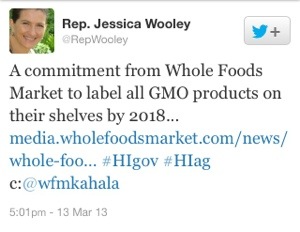
Tweet made by Rep. Wooley back in March 2013.

Last night at the Kaneohe Neighborhood Meeting, I had the opportunity to talk to a fellow resident. She came to the meeting because she wanted to speak out about an issue she was having with where she lived. Her and fellow tenants live in an affordable housing complex and were being subjected to a huge increase in rent because the units were sold by the City and County to a mainland developer.

She continued to share her story with me about her life and why she came to the meeting. She has worked as an educational assistant at Castle High School. She’s employed but doesn’t make a whole lot of money so a rent increase will leave her with only $100 left over each month. She could live with her daughter but wants to remain as independent as possible.  It’s a struggle to make ends meet but she does it.

I really started to think about this more later on. There are a lot if people who are in a similar situation to her. Any local person will tell you that cost of living here in Hawaii has been rising. We hear and see it everywhere. Everything is going up: gas, electricity, basic groceries, property taxes, rents, car registrations, sewer fees, and so on. The only thing not going up is our income to keep up with this, and that is a major problem.  So many folks are struggling and living paycheck to paycheck as well as working multiple jobs to get by.  How can one have quality of life when most your time is spent working just to survive?

Earlier in the year, there was a Star Advertiser article that looked at the poverty issue here in Hawaii with kids.  The percentage of kids living in poverty was 12.5% in 2005.  This year’s Kid’s Count Report found that there were 51,000 kids living in poverty, which is up to 17%!  Then when you look at poverty in seniors, the AARP has found that nearly 20% fall into that category.  There are a lot of people in need in our state and what is being done to address this?  How can we make peoples’ lives better?

As I listened to her story, I really thought about the politicians of Hawaii and how they get into offices making lots of promises that we know can’t be kept.  Or there are issues that they bring up that don’t really help anyone other than their own personal agendas most of the time.  It was really nice to see many local looking folks, most of whom were born and raised here and had long time established families in our communities.  As the residents of Kulana Nani apartments sat in the meeting waiting for their turn to speak up, I could not help but think more about this issue.

In the back of the room, I noticed that Rep. Jessica Wooley came in and sat in the back.  When it was her turn to speak up, I had to ask her my question.  “As you know, many people are struggling to keep up with the cost of living here.  What are you planning to do as ag chair to help address this issue to keep things affordable as well as keep farmers in business?”

Her answer was that she realized that many farmers are at risk for going out of business and that we need them and she has various programs and things in the works to address this.  We all know that when costs go up for farmers, their products will cost more also, which is why local produce tends to be more pricey.  Not once did she go on about the labeling issue for biotech food in this answer.  I know for a fact that the labeling will mean that food costs will go up since manufacturers will have to specially label food just for our state.  How is that really going to help keep basic foodstuffs affordable for people who are already struggling?  She didn’t bring up that issue until my second question for her, which I’ll continue on another blog post.

Politicians like Wooley and others like her who have decided to align with the activist groups like Hawaii SEED, the Babes Against Biotech, Hawaii GMO Justice Coalition, Hawaii Farmers Union United, and the Hawaii Organic Farming Industry are all about self serving their own interests.  They are pushing to grow their industry that may increase availability of organic produce but at a cost that most folks can’t afford.  They have plenty of money to fly between islands, stay in hotels or other accommodations, or get funded by their supporters through subscriptions or gofundme.com and don’t have to work like the real local people.

When you have a lawyer for a husband who makes a decent salary and a property in San Francisco, it is easy to tout your agenda.  It’s easy to listen to activists’ cries for a label for food that many of them consume for the sake of pushing your agenda and forget about your real constituents that struggle for years.  Have some empathy for these people Rep. Wooley for they are who you need to work for.  A good leader will look at all the issues, use evidence and best practices to help solve the problem, which is always more complex that what it appears.  Remember that you were elected by the very people in your community and should be lending your ear to them first and foremost, and not to a Babes Against Biotech activist or an outside environmental attorney, whom you fondly call Andy Kimbrell.

Listen to the Farmers Representative Wooley

A few weeks ago at the Kaneohe Neighborhood Board meeting, I had the chance to talk in person to Representative Wooley.  She mentioned that we can contact her as to what laws she’d like us to consider for the upcoming session.  I decided to take her up on it and sent her this email tonight.  If you’d like to share a word or two with her you can contact her at repwooley@gmail.com or repwooley@capitol.hawaii.gov

Aloha Rep. Wooley,

I spoke with you the other night at the Kaneohe Neighborhood Board meeting and would like to take you up on the offer as far as what kind of legislation I’d like to see regarding agriculture in Hawaii.
As a daughter of a long time farmer and farming family for nearly 4 decades, I really think that as a leader, Hawaii needs to consider the bigger picture.  Your statement to me that we need to change the meaning of agriculture is very disturbing because for Hawaii. It is not only food that needs to be grown here.  We have many other thriving industries here from seeds to nursery plants and other non-food crops that would not fall under your umbrella definition.  If we want to grow more food, just going after the seed industry isn’t going to solve the problem.  As a leader, I would hope that you could see that.  That is a very linear way of looking at the problem which ultimately never solves anything.
If the goal is to grow more food in Hawaii, we have to look at all the issues that affect why we aren’t more self sufficient.  Look at the whole system to address the best way to reach the intended goal.  When you look at those issues like energy costs, labor, supplies, land issues, and the other factors, you can have a better view of a more holistic plan of solving this issue.  The problem has to be solved systemically.  Your simple solution of changing the meaning of agriculture to growing of food and asking for label for biotech food does nothing to make food more likely to be grown in Hawaii. It places a line between farmers and that is not what is needed.  As a leader for the agriculture committee, how can you best serve the farmers, not just a certain faction of them but all farmers?
Does siding with one kind of farmer do anyone any favors?  No, it doesn’t.  You as a leader need to band together all farmers to solve these problems.  That is the responsible thing to do.  Where does the research and evidence lead to?  That should be your guide through all of this.
I must also note that your broad statement that there is no regulation about GMOs is patently false.  If that were the case, why is it taking such a long time to get through the process to be approved?  I’d really appreciate it if you’d be more honest when talking about the issues.  You know darn well that there is many tests that have to be presented before anything is approved by the FDA, EPA, and USDA.  You may not be happy with the process, but don’t state outright lies about the issue.
I’m counting on you, as well as many the younger generation of farmers, who are hesitant on whether or not to continue family farms in this current environment.  They need to know if you are really going to be a proponent of agriculture and education and plan to secure the future of ag technologies in Hawaii since you stated that there will be an education campaign.  It may not make you popular to your activists but do the responsible thing for the real people who work and support agriculture in Hawaii.

Hawaiian Electric Company Promotes Greenpeace Pseudoscience

IMG_0160

I recently received this lovely, glossy magazine from Hawaiian Electric Company in the mail a few weeks ago that I decided to browse through it.

As I was reading through it, two things caught my eye.  Note what this has to say about ways to improve your health by eating more fruits and veggies, but to go organic.  Hmm…  There is no mention that there isn’t a significant benefit found for eating organic though but it touts it.

IMG_0176

Then there’s one about The Environmental Working Group’s advice on sunscreens.  That’s the same group that does the list of dirty produce which is a scam piece of advice also.

IMG_0178

Then there was also this one too in there about drinking alcohol.

IMG_0175

The most disconcerting statement on their list is this one, “Cook Without Chemicals.”  Um, HECO, everything is made of chemicals!  Even the American Cancer Society does not support this statement.

IMG_0177

If you are going to promote being efficient and lowering our impact on earth, going organic doesn’t translate to a more healthful product according to studies comparing it.  Just the labeling of something can influence one to have a different idea about it even it if is the same.  HECO is promoting this kind of information without any source and then people just believe it.  It also makes people who can afford organic feel bad for purchasing conventional food for no reason.  Shouldn’t this publicly funded organization be considering the evidence when it publishes things like this?  Isn’t that the responsible thing to do?  I’d think so.

The worst offending piece of information that I found in there was this gem.  Come on now HECO, Greenpeace?!  Really?

IMG_0174

I always find it interesting that I get these mailers about going “green” in the mail since how many people actually read it and will use the information before it hits the trash can?  Is that really going green?  I also learned a tip or two from my brother that these kind of magazines with gloss coatings are not recyclable either and aren’t too biodegradable either.  I’m starting to realize that this green movement is kind of like a sham full of hypocrisy!

Hawaii SEED Wants to Destroy Papaya Farmers

The Hawaii SEED version of Greenpeace photo shot.

Walter Ritte and his Hawaii SEED group are definitely helping farmers deal with issues, especially with papayas.  They are spending lots of money to test for GMO “contamination” so they claim but what have they done to solve the real problem that was happening?  *Crickets*

They did nothing.  That’s right, literally nothing. When farmers were getting hit in the 1990’s by the ringspot virus, they were no where to be found.  Nada, not around nothing.  Here’s what Hawaii SEED has to say about themselves: 

Hawai`i SEED incorporated as a non profit 501(c)(3) in September of 2005.

The corporation is organized for charitable, educational and scientific purposes to educate the public, government and business community about locally-based agricultural systems that create real food security for Hawai‘i and about the risk posed by certain agricultural and food systems while protecting human health and the environment.

Activities of Hawai‘i SEED include bolstering the community of sustainable farms and farmers throughout the state of Hawai‘i. By providing workshops to farmers, we hope to deemonstrate alternatives to genetic engineering. Hawai“i SEED facilitated the public testing of papayas for citizens throughout the state to determine if their fruit is contaminated with genetically engineered organisms.

Hawai‘i SEED also conducts general outreach to raise awareness about genetic engineering and alternatives to genetic engineering at public speaking events, and media outreach. We also give presentations to agricultural and other community groups about GMOs and their alternatives.

Note that they are not about research and contributing to agriculture but more about blocking what has been done with papayas.  What is even more disturbing is this statement:

While the GMO Papaya is resistant to papaya ringspot virus, it brought many more problems than it solved. The GMO Papaya has closed lucrative export and organic markets and always has a low price point. This technology has come with too many strings attached and Hawaii has lost almost half of its papaya farmers.

This group constantly touts anti-GMO wording like contamination and so on to disparage papaya farmers and wonders why papayas don’t sell well.  They proudly proclaim how they help test for GMO papayas but what good is that?  Why not spend that money creating your non-GMO virus resistant papaya if you really want to have sustainable agriculture?  

Then Hawaii SEED has to go on complaining how Hawaiian papaya is not being accepted in the worldwide market.  Um, if you’d stop spreading untruths about it, maybe more consumers would not be so afraid of our Hawaiian fruit.  Support all papaya farmers and maybe you can sell it better to help all farmers.  Hawaii SEED is not about doing farmers good, they are about taking things away like all activists.  They contribute nothing to Hawaii agriculture.  That’s the bottom line with these folks because it is all about taking and not giving.  

This group is a far cry from local folks too as we know it is being funded by outside contributors big time.  The truth is that Mr. Ritte enjoys his papayas and doesn’t care if it is GMO or not because he knows that it is fine.  Remember the March ag day Mr. Ritte?

A Farmer’s Say Doesn’t Matter in Hawaii

It is so easy to sit back on a computer and have your opinion about how you  want your food grown.  You have a comfy chair to sit on, a nice computer with a quick internet connection, a fan to keep you cool, and a well stocked refrigerator to sustain you as you comment away on the social media.  That is how you are going to change the world to get farmers to grow food your way.  No. Never.

It is so easy for Jessica Wooley, Russell Ruderman, Mike Gabbard, Tulsi Gabbard, Gary Hooser, Billy Kenoi, and Brian Schatz to dictate the policies that they want done for agriculture because they have nice cushy offices and are guaranteed a paycheck, courtesy of the taxpayers.  They would rather stay in those positions then be on a farm any day.  Why do you think they are in office to begin with?  Farming is just too laborious and risky, while political office is a clean, stable position for life.

As much as these politicians are the listening to the public’s opinions, they have no qualms in ignoring the farmers, ranchers, and scientists testimonies on the future of agriculture.  We’ve seen that what is found on the internet and repeated as truths is much more valuable then the experiences of people who tend and till the land.  They have no say in the issue and are at the mercy of an uninformed public fear mongered beyond belief.  That is the direction that Hawaii is heading when we only consider public opinions for laws.

Our leaders talk about how they want to grow our ag industry in Hawaii but their actions speak otherwise.  Laws upon laws have become huge burdens on our farmers.  From business regulations, taxes, federal food safety laws, labor laws, county laws, and state laws all weigh upon these farmers who are growing food and cultivating the land.  We also can’t forget the outside factors that affect farmers too including energy costs, shipping costs, and being at the mercy of the weather.  These regulations may seem helpful on the outside but make the business and practice of farming less and less attractive.  With all the anti-technology laws being placed upon them also by Kauai and Hawaii county, how much more can these farmers take when potential tools are being kept from them?  What can our farmers do when their hands become tied by the wishes of ignorant politicians and an ignorant public?

As we see more and more farms closing down because of the regulations that our leaders have placed upon them, we get to thank each politician for being responsible for the demise of these farms.  The younger generations do not want to continue family farms because it just is too burdensome.  Would you take a job where your income isn’t guaranteed and bad weather can wipe out your entire crop?  What if the bugs eat up all of your crops and you can’t even use a tool that could help it because some politician said that you can’t?  Imagine having a job where you have to know everything about the tax, labor, and food safety laws to a tee to stay in business.  Not only do you have to manage those issues but you also have to physically work hard to get your product out to your consumers also.  Lastly, you are subject to criticism, thievery and even threats of crop destruction as part of your job description.  That sure doesn’t sound like a very attractive job to me at all. Our politicians have decided that this is the route they want to take with agriculture with their recent actions.  That’s the Hawaii that our leaders apparently want for our future of farming in our islands.

The Real Problem is not the Anti-GMO Club

pointingfinger

As I was talking to my husband tonight about the whole issue with agriculture and the divisiveness going on, he made a statement that really hit me.  I was complaining about how a local farmer, whose crops were getting stolen, did not want to go on television to share his story.  I explained to him that they were shy about it and didn’t want to be out there.  Then my husband said, “Well, then you guys will all lose.”  I wanted to fight back and say something but as I internalized it, he’s right.  “If the silent majority continues to not speak up, then they will ultimately lose and we all will lose.”

No one wants to be at the end of a losing battle but in reality, in some ways he’s right.  The local folks will sit back and complain about what’s going on and then do nothing about it but complain.  Where does that complaining get us?  Does it solve the problem?  No.

Whenever there is a problem, one must realize that by seeing it, we are all a part of the problem.  If we don’t recognize that, the problem can never be addressed.  While many local people are starting to become more vocal about how we are being taken over by these activists, we are not doing our part.  This loud, brazen minority has taken advantage of the culture of Hawaii and used it to their advantage.

Local style ways are pretty simple and learned from the good old plantation days where there were people from all over the world.  Koreans, Chinese, Hawaiians, Portuguese, Filipinos, and Japanese were all joined together to work on the sugar cane and pineapple fields.  There was a unique culture developed through this relationships, much of it a mixture of the cultures.  Even a special language was born through all of this called pidgin that can only be heard by local people.

The local culture was pretty simple and based in respect.  Don’t talk stink about others.  Do your work good.  Respect your kupuna or elders.  Don’t make waves or attract attention to yourself.  No make shame on your family.  Work hard.  It was laid back in its ways really.  No one wants to speak up to get others mad or gain attention to yourself, just be a part of the masses.  No make trouble, just leave it the way it is even if you don’t like it.  Over the years, a huge sense of complacency has been developing as a result.  It’s pretty evident when you see bumper stickers that state, “Ainokea.”  That says it all… I don’t care.

When you look at the low voter turn outs in our state, that just shows how people don’t even bother with the issues nowadays.  The same goes for agricultural issues here in Hawaii.  How many times have you heard a local farmer speaking out for an issue?  There are thousands of farmers here that were born and raised with long time family traditions rooted here.  Where are their voices in the whole issue?  I hardly hear or see of it but I do hear the complaints from others who don’t like what’s happening.  This really sends the message that no one wants to stick their head out about the best direction to take based on their expertise and experience.  The anti-aloha activists and their politicians have seized on this opportunity and are running the show now.  Is that what is best for Hawaii?  These are opportunists supported by ill-informed people supported by lots of outside monies?

So, if you don’t like what is happening to our agricultural industry in Hawaii, you the local born person, go walk in front of the mirror.  Don’t point your finger at the anti-GMO club and blame them.  Point that finger right at yourself and say, “Hey, you!  You are the problem.  Yep, I said it.  It’s you who don’t have the guts take a stand.  Don’t like what’s happening, eh?  Den you bettah speak up do something about it and stop wasting your energy complaining.  You da only one who going fo suffer.”

Wake up local people.  There is a new culture developing in our islands that if you don’t adapt to it, you’ll have to pay the price for your silence.  It’s time for the local folks who don’t say anything to speak up, vote, and say something to help your fellow long time local farmers.  If you don’t, who will?

One way to start is to sign the petition to speak up for farmers!


Related articles