Jessica Wooley Wants to Redefine Agriculture Rather Sink Farmers

I realized last year, with the brouhaha of the failed labeling law, that we do not have enough local voices in politics. I decided to start participating in the neighborhood board meetings. I have been attending these meetings monthly since June this year.

At this last meeting something very peculiar happened. Jill Tokuda and Ikaika Anderson’s representative attended as usual and are very regular in their participation to notify the community of what’s going on and what they are working on. The others like Clayton Hee, Cynthia Thielen, and Ken Ito, are non-existent. Jessica Wooley will send a representative twice but never attended it herself since June. At this past month’s meeting, no one on the board recognized her, and as a result, and mistook her for another presenter.

She did a quick report on what she plans to do as the agriculture chair. Basically she wants to redefine what agriculture means in Hawaii, referring to calling it the growing of food. I asked her what she will be doing to help farmers. She also talked about attempting to get that label on biotech derived foods and stated, “there is no regulation” on it. Of course she continued stating that consumers should be able to know and that papaya farmers are already doing it for export and it won’t shouldn’t affect them by doing it here. She did also state that, “I would not ban GMOs.”

As I listened to her answers and statements, I started to think more about what she was saying. Okay so you feel that there is no regulation, which is completely false, and that a label is going to suddenly create this sense if transparency that her “constituents” want. Something doesn’t make any sense here.

Why is a label suddenly going to solve the transparency and so called “right to know issue” after you just stated that there is no regulation? If you are so concerned about no regulation, then why don’t you work at the federal level to start these regulations that you claim there is none? Doesn’t that make more sense? If you were to travel to somewhere else, as a consumer, you won’t be able to get your right to know since there is nothing across the board by state. A consumer could unwittingly eat GMOs at a restaurant and that would be such a travesty too because that is not labeled!  Even the locally produced foods like papaya seed salad dressings to some locally made taro chips would all need a label too so that these folks’ right to know are fulfilled and that they are suddenly enlightened by this label!  Poor Hawaii constituents would not have their rights respected Ms. Wooley if they were to go to a Las Vegas Trader Joes! You’re not protecting peoples’ rights! What a non-tragedy!

Of course Ms. Wooley doesn’t show her transparency when it comes down to who’s feeding her this information. She is well connected to anti-GMO groups like Center for Food Safety attorney, Andrew Kimbrell, and is married to David Henken of Earthjustice. Take a look at what these people say about why they want this label from the Genetic Literacy Project.
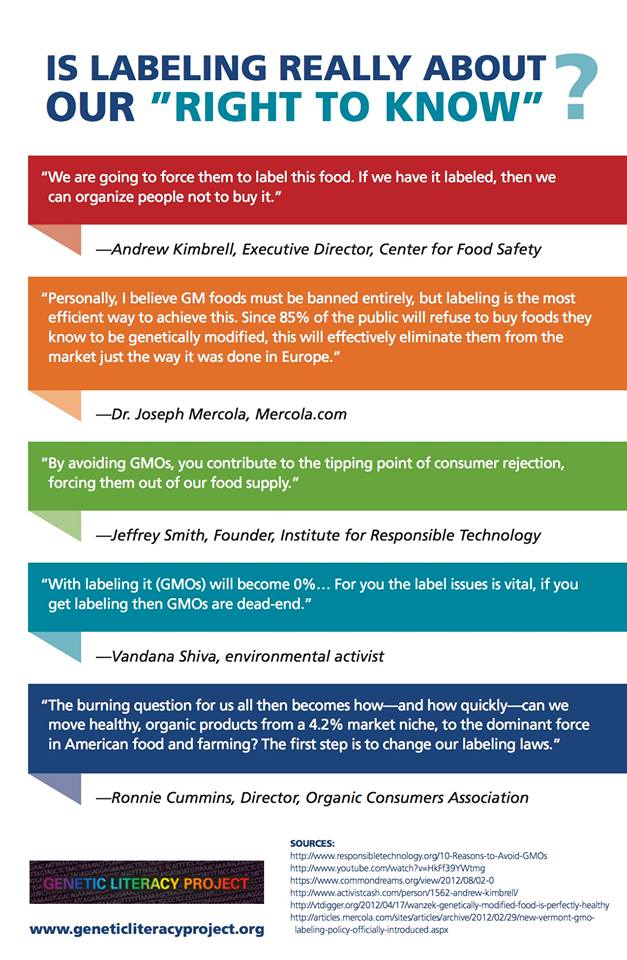
genetic literacy

Knowing all of this, I asked her if she was aware of what is happening to many small farmers in the community. I shared with her, as well as all the board members present, about how some farmers reported being asked if their bananas and produce were organic.  When it was told to the person that it wasn’t, the questioner tossed it aside very rudely and marched away in disgust.  Jessica raised her eyebrows stating that she was not aware of this and it should have turned into a police report of some kind.  I told her that these farmers are afraid to speak up against this and become targets.  Local people don’t speak up against these activists for that very reason.  I’m not sure which planet she lives on but these anti-GMO activists have been doing this for some time already and there was a public incident with this already that made the news.

We all know that there is a lot of hope in the anti-GMO movement that somehow this is going to make people eat healthier.  Do you actually think that a little sticker on a package is going to help that?  When those fat free labels appeared on food stuff did it make people eat better?  Uh, no.  Shame on her for thinking that this really is going to make a difference all to earn more money from consumers marketed with fear.  That’s where shortsighted thinking in politicians get us no where.  A label isn’t going to change people’s weights! Education about healthy eating is!

If Jessica Wooley is really wanting the focus of agriculture to be on food and growing it, I suggest she rethink her strategy.  Making more laws against farmers isn’t going to make more people want to get into farming.  It already is a difficult business to stay afloat given the high costs of land, labor, and supplies.  It doesn’t help that weather, disease, and other uncontrollable variables can devastate your whole year’s worth of work either.  If you make laws to limit the tools and research in agriculture, that itself will make it even less viable as a profession.  Does that mean your out to kill farming that isn’t organic because it sure appears that way?

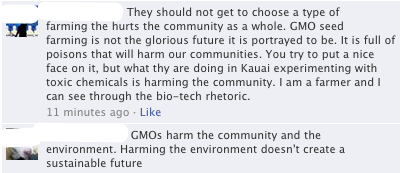
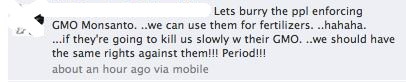
I was sent some commentary about the petition that was posted to help open up a forum for others to speak up for our farmers.  This has created a small storm of controversy in the GMO Free Groups of course and someone sent this comment to me.

selma

I find it amazing that her GMO Free followers actually get it but they just don’t connect the dots about what they say.  Yes, farmers are poor and why are you making it harder for them to do their job Ms. Wooley and GMO Free groups?  Wouldn’t it be better to ask them, “How can we make your job easier so you can do what you need?”  That would be a much better option then outright stating that you need to label your produce because your right to fair treatment is outweighed by the needs of activists.  That’s a pure kick in the face to our farmers.

If Wooley is about fulfilling her role as someone who wants to make Hawaii better as a transplanted local, she needs to take off the anti-GMO hood and stop wasting our taxpayer dollars on that little label of hers.  If she really wants to help people live better, have more farmers, and grow more food, she needs to get off her “right to know” “label it” podium and reinvest those monies and resources back to the farmers and towards educating the public about healthy eating if her motives were right.  But we all know the truth about her agenda here which is plain to see where she wants to take small papaya farmers…  Into extinction.

Jessica Wooley: What are you doing in Maui?

Jessica Wooley is the representative for District 48 – Kaneohe, Heeia, Ahuimanu, Kahaluu, Haiku Valley, Mokuoloe.  She is also the representative who was one of the introducers of the GMO labeling bill last year that caused a whole bunch of drama and controversy, especially to the growers of transgenic papayas.  In my opinion, she is one of the key reasons why the GMO issues is growing so heated here in Hawaii.

Well, you would think that as a representative of this area, she’d be really looking out for her constituents.  Well, if you have papaya farmers in your area, some of whom grown transgenic crops, wouldn’t you want to hear from them how your law would affect them?  Apparently not.  She’d rather align with the Babes Against Biotech because that’s her interpretation of representing constituents.  What?!  Why isn’t she listening to people like my dad who has lived in that district and farmed that area for as many years as she has been alive?!

Well, as a representative, shouldn’t she be solving problems in her area that affect the residents?  One big problem is the flooding that occurs by Waikane stream every time there is a heavy rain, which is pretty often.

Here’s some stories documenting this issue:

http://www.hawaiinewsnow.com/global/story.asp?s=11387854

http://the.honoluluadvertiser.com/article/2004/Mar/03/ln/ln11a.html

http://www.clipsyndicate.com/video/play/1972377/waikane_flooding_solution_still_years_away

http://www.hawaiinewsnow.com/global/story.asp?s=11381327

This flooding issues affects everyone who lives and drives down to the Windward side.  With the rainy season upon us soon, you would think that someday someone will do something about it?  Um, no.

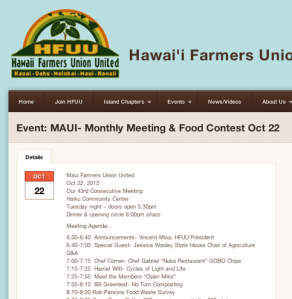
Jessica Wooley is out and about spreading her word for organic farming methods on Maui.  Yes, she’s not working hard for her constituents in the Waikane area, but on Maui.  She’s talking to farmers there.

Screen shot 2013-10-23 at 10.50.06 PM

HFUU is known to support a lot of the anti-GMO activists

If you take a look at their board, it is very clear that they are not about coexistence in farming.  But alas, we know why Jessica is aligned with these folks.  She’s also married to an environmental lawyer, David Henkin, who has engaged in many lawsuits against the state.  Earthjustice was the same group who attempted to block the irradiator project which they got moved away from the airport to Kapolei instead.  That same irradiator was built to help grow an export industry for Hawaii grown products.

Henkin has been not as open because of his wife’s elected position so his fellow Earthjustice attorney Paul Achitoff  is at the forefront instead.  He is yet another anti-ag supporter too when his videos about Monsanto are used by the anti-GMO groups frequently.

It’s quite sad to know that the representative for your Congressional district as well as your own local representative is out to destroy family farms.  Many of these farms that have been around for decades and have been good stewards of the lands.  The green movement that Jessica Wooley is supporting is not about the supporting local people, its about what Earthjustice wants to do to the ag industry….  Destroy it.

GMOs Banned in Hawaii!

November 2020

Ban-GMO

Hawaii has succeeded in becoming the first state of the nation to completely ban all GMOs .  It comes after a long battle between politicians and their activists and big ag in the state that started back in 2013 with two key bills being passed by county council members.  The early roots of the GMO ban started when a moratorium was passed against any research of the taro or kalo.  Subsequent efforts were started in thanks to Jessica Wooley and her Bill 174 to label GMOs which eventually failed to pass.  However, thanks to the efforts of Gary Hooser and Tim Bynum with Bill 2491 and Margaret Wille and Brenda Ford with Bill 113, subsequent laws continued to follow to suit to limit and eventually restrict biotechnology across of our islands.  Tulsi and Mike Gabbard also were successful at the detrimental labeling of GMOs too which helped to lead to more consumer fear and misinformation, despite their promises to the farmers for an educational campaign to support it which never failed to materialize.

Meanwhile, during all of this furor of anti-GMO sentiment, our sustainable agriculture industry has been suffering many set backs over the years leading up to the eventual ban.  Many local industries have been hit very hard by the lack of tools and technology left for them to remain at the helms of their farms. In a recent survey, the number of farmers had dwindled down to less than .5% of the population and shows no stopping the declining numbers.  As a result of these kinds of restrictive laws placed on farmers, imported food has risen to 98% which was an unintended consequence of these laws due to the black marketing campaign of the organic industry and public pressure on politicians.

Below is a summary of what has happened over the years to certain ag industries in the Islands:

Kona Coffee

The Kona coffee industry has suffered tremendous losses since the initial introduction of the coffee borer beetle (CBB).  It was hopeful that the spraying of Beauvaria Bassiana would control for this beetle.  It worked to minimize the millions of dollars worth of damage being done but it was found that the CBB has developed a resistance to the B. bassiana within a 5 year period that was discovered by a farmer after finding more and more of his crops destroyed.  The industry has also been hit by the spread of coffee rust around the islands due to the recent increases in hotter weather and drier conditions leading to more plant stress on the coffee trees.  The entire coffee industry is at 20% of what it used to be and is mostly being sold as high end niche market products due to the rising costs of production.

Honey

Unbeknownst to the the local beekeepers on the Big Island, the spraying of B. bassiana had a devastating effect on their bee population.  Recognized by the Xerces Society as being highly toxic to bees, the overspray of this organically approved pesticide had residues that affected local bees.  The honey production dropped significantly as the lack of biotech research was banned and the already threatened bee population declined even further with the varroa mite and then increased pesticide use.  Honey is no longer being produced on the Big Island as a result of the demise of the bees.

Papayas

The papaya industry has been completely obliterated by the passage of Bill 113 and the successful lobbying of Tulsi Gabbard’s labeling law passed at the federal level.  Just as Japan was starting the importation of Hawaiian papayas and farmers increased production, the misinformation being spread by the labels caused a tremendous drop in domestic sales across the country.  The demand for the fruit dropped to a mere 10% and took a tremendous dive.  The lack of education as promised by our Congresswoman failed the industry and Hawaii no longer exports papayas as a result of her labeling effort.  Mexico has now become the dominant leader in papaya exports to Hawaii and the mainland US which has had several problems with salmonella contamination and multiple recalls and illnesses.

Pineapples

The pineapple industry has also taken a huge hit in production due to the banning of biotechnology as an imported pest from Mexico caused huge crop destruction across the islands.  With limited ability to use modern pesticides and biotech advances, the entire Hawaiian pineapple is just one a faint memory of our rich agricultural heritage in the islands.  The only fresh pineapples are currently being imported from South America as the state is no longer able to produce these cost effectively.

Kalo

The kalo has also become extinct in our islands also.  With the recent introductions of new pests from imported produce from China and Mexico, as well as the recent prolonged dry spells.  The taro has suffered multiple set backs despite the efforts of the farmers to mitigate the stresses of disease and pests.  The moratorium on the research of taro and resistance to revisit the bill was not removed in time to save the taro from its fate.  The Hawaiian staple of poi is no longer available as a result of the lack of tools and acceptance of biotech to help combat the demise.  Currently, taro is being imported from China and being researched on how to create a similar substance to that of poi.

Cattle 

The once growing demand for locally raised beef was undermined by the efforts of the multiple anti-GMO bills passed in the islands.  Ranchers who’s livelihoods were continuously attacked for their use of GM feed have found that they no longer are able to continue their profession, as the the cost of ranching severely impacted their ability to remain financially viable.  Local milk production has also ceased operations also and all milk is imported into the state due to the high operating costs resulting for the GMO bills.

Other impacts and unintended consequences of the GMO ban:

After initially opening up the UH Cancer Research Center, the ban on GMO inadvertently blocked all research on the latest cancer treatments that were GMO derived.  Scientists and researchers’ works were completely halted as the ban covered all of organisms being used in the state.  Just as they were on the verge of finding a treatment for breast cancer focusing on genetic modification, the attorney general concluded that such research was considered illegal under the law.

The cost of food production rose 30% following the ban due to increased enforcement and regulation on the determination of genetically modified food. GMO food stuffs had strict requirements and testing was enacted as a result.  Testing of the quantities of modified foods were the major reason behind the rise in food costs.  In addition to Hawaii already paying higher food costs, the costs are approximately 40% greater than costs on the mainland.  Poverty rates in our islands has increased from 17.4% in 2013 to nearly 25 to 30% due to the high costs of living factored in.

With the lack of big ag on former cane and pineapple lands, the sustainable organic ag industry supported by small organic farmers has taken a great toll on the capability of the state to manage the current infrastructures.  Land leases to these small farmers have had to rise to help cover the costs of maintaining ditches and water tunnels used for the ag areas.  Pest management has also become a problem due to the fragmented systems utilized by these small farm plots.  Farmers have also had decreased sales as the rising production costs cannot keep up with consumers ability to afford locally grown products.  The infrastructures presently in place have significantly deteriorated as a result of the system change resulting from anti-big ag bills being passed.

The loss of big ag has also affected a key educational system for the native people in our state.  With the lack of reliable tenants on the large stretches of property owned by Bishop Estate, Kamehameha Schools has had to decrease the amount of student aid being provided to existing students and discontinue educational programs being supported by those leases.  Bishop Estate has had major losses of revenue on evictions of these small farms that could not pay market prices for ag property.  They have also suffered losses for covering the maintenance of the existing infrastructures in place that small farmers are not able to bear the burden of.  Many Hawaiians are now on waiting lists to get access to the programs that they were once eligible for.

The recent closures of the seed companies on Kauai has had an especially devastating effect on the island.  Unemployment has resulted in drug use, property crime, and other crimes have tripled as the companies have transferred operations to foreign countries due to intense regulation.  Small organic farmers have tried to use the former seed lands and due to the lack of financial backing have not been able to keep up with rising lease payments to cover infrastructure maintenance.  Due to the inconsistent practices of small farmers and a lack of integrated pest management, yields on these farms have been very poor leading to smaller production.  Inconsistent soil management practices have also led to severe run off problems from the fragmented farming systems created.  Pesticides residues of organically sprayed chemicals have also been found in schools and hospitals at significantly higher levels due to the lack of regulation on these farms.  New reports of skin, asthma, and allergic reactions have been increasing as newer studies are finally testing these pesticides against humans.

With the loss of agricultural lands, the barren farms have been a developers dream come true as more homes and infrastructure plans are in the works.  Due to the isolation of Lanai and potential for power generation, a nuclear power plant is likely going to be built there to power the entire island chains affordably.  The increase of homes in Kauai has also led to the building of the next biggest freeway system in Hawaii, H4.  The Big Island has also had a huge growth in housing and larger freeway systems are in the plans to be developed.  There has been a boom in the construction industry here with the lack of agriculture.

One of the biggest and most detrimental effects of the ban of GMOs is the huge brain drain occurring in our islands.  As the biotechnology sector grows in both the agricultural and medical sectors, the outlook for students pursuing  these careers were bright prior to the ban.  The occupational diversity of our state was glowing prior to the politicians’ decisions to ban this growing sector.  Currently, the major industry in the islands remain in the tourism sector primarily and the lack of more skilled opportunities have led to yet another brain drain effect.

The constant sense of threats and disrespect up until the enacted ban on farmers have cause many farmers to cease participation in farmer’s markets.  Many live in fear that they choices that that they have used to farm has put them up as targets by the activists that were first seeking a label then a ban.  Many have decided prior to the labeling that the farming business is no longer worth it anymore with the added stressors of the activists.  The farmer’s markets have dwindled as the local food supply is dropped dramatically as a result of protesters and activists bullying tactics to farm according to their demands.

So although at the time these regulations seemed like “common sense,” the unintended consequences of this strategy has left many current leaders and a growing number of local people asking themselves, “Where did we go wrong?”  What was supposed to be the “right” thing at the time, has not created the vision that it was intended to do.  It was to create an affordable and sustainable food supply for our state according to what the organic industry was touting as the right way to proceed.  How do we get off the wrong path and get back on track and how do we reverse the permanent damage done?

If our ag industry continues to be badgered and splintered the way it currently is heading, this unfortunately will be the likely consequences of our present actions.  Hawaii can avoid this predicament that is highly likely given the nature of the situation now.  Leaders have to think prospectively and consider the evidence presented to make responsible laws, not ones based on “common sense” and public opinion.  If you don’t want to face the scenario presented, then we must change our path now before it is too late.

Popular Opinion and Politicians

Excerpts from the US History site:

Over 127,000 United States citizens were imprisoned during World War II. Their crime? Being of Japanese ancestry.

Despite the lack of any concrete evidence, Japanese Americans were suspected of remaining loyal to their ancestral land. ANTI-JAPANESE PARANOIA increased because of a large Japanese presence on the West Coast. In the event of a Japanese invasion of the American mainland, Japanese Americans were feared as a security risk.

Succumbing to bad advice and popular opinion, President Roosevelt signed an executive order in February 1942 ordering the RELOCATION of all Americans of Japanese ancestry to CONCENTRATION CAMPS in the interior of the United States.

Evacuation orders were posted in JAPANESE-AMERICAN communities giving instructions on how to comply with the executive order. Many families sold their homes, their stores, and most of their assets. They could not be certain their homes and livelihoods would still be there upon their return. Because of the mad rush to sell, properties and inventories were often sold at a fraction of their true value.

When the order was repealed, many found they could not return to their hometowns. Hostility against Japanese Americans remained high across the West Coast into the postwar years as many villages displayed signs demanding that the evacuees never return. As a result, the interns scattered across the country.

Note some key terms in what happened to the Japanese Americans in this excerpt that a politician succumbed to popular opinion and bad advice when enacting this order.  It was based on no evidence and paranoia against a made up perception of an enemy.  This so called enemy created hostility against it that continued for years and resulted in discrimination and prejudice for years after that.

As I read this, I’ve come to realize that there are many parallels here to what is happening in Hawaii with Bills 113 on the Big Island and Bill 2491 on Kauai, as well as last year’s labeling bill.  The same events are happening here in our islands.  There is no evidence to base these laws on and a whole lot of paranoia being spread by the organic industry’s tactics to misinform the public.  All kinds of propaganda is being spread against this perceived evil technology that is based in fear but no evidence.

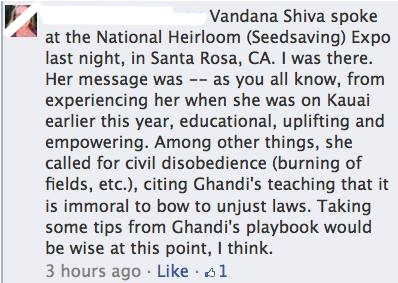
Then we have irresponsible politicians like Gary Hooser, Tim Bynum, Brenda Ford, and Margaret Wille, seeking the bad advice from propaganda spreaders like Jeffery Smith, Andrew Kimbrell, Ronnie Cummins, Vandana Shiva, and Bill Freese.  These people are not scientists nor have any background to make the claims that they do but are believed by these politicians and their activists.

Despite the fact that this perceived evil could provide that environmentally friendly, sustainable world that they want, it will never be able to be accepted into mainstream until many years down in to the future, when the propaganda dies down and we no other options left.  The scientific evidence tells us that this technology is safe yet it is rejected by the popular opinion that has been bombarded in fear and misinformation and nothing else.  (Our ancient societies recognized this phenomenon well and coined the phrase, “They condemn what they do not understand.”)
The Japanese people suffered years of discrimination and prejudice because of what was the popular opinion at the time.  They carried on and despite the hardships, eventually became powerful figures in the communities.  The biggest example of this persevering spirit is Dan Inouye.  In agriculture, it is the papaya that is the shining example of this technology.  The corn, soy, and other plants are still facing this discrimination but is still toiling on and producing our food and textiles.  They are being continually touted as evil but have become necessary tools for the farmers that produce the things we need.  The farmers who use these tools have become the perceived enemy of the moment which they should not be.  I say respect their wishes to use this technology and the research and science that supports it.

The word pono is always mentioned in these divisive conversations.  Do what is right!  What is right here to begin with?  The pono thing is to use the evidence built over the years and base decisions on that, not on the popular opinion of the moment.  Our politicians are succumbing to bad advice and the bandwagon of the moment protests of ignorance.  Do we want to repeat the same mistakes in history by outrightly rejecting this tool that so many have minuscule understanding about?  Where is the science and technology leading us to?  The future is in genetics and genetic engineering but so few here have no clue about it.  That does not mean that we automatically disqualify it out of their ignorance.

If only politicians could instantly get a research and science degree and then take a look into a crystal ball of the future.  It would change their shortsighted thinking in an instant to know the possibilities.  Right now, these popular politicians are blinded with Monsanto glasses like their ignorant followers too.  That is not what we need in Hawaii.  Slamming the door on technology does not do any of us favors to address our future needs of sustainability.

Do the right thing for once Gary Hooser, Tim Bynum, Brenda Ford, Margaret Wille, Tulsi Gabbard, Mike Gabbard, Jessica Wooley, and Russell Ruderman. When it comes down to setting the standards to make those laws, use the evidence presented.  That is your responsibility to the people and farmers and ranchers of Hawaii…  Laws should not be based on popular opinion and bad advice of your loudest activist.

The World Does not March Against Monsanto

mam13

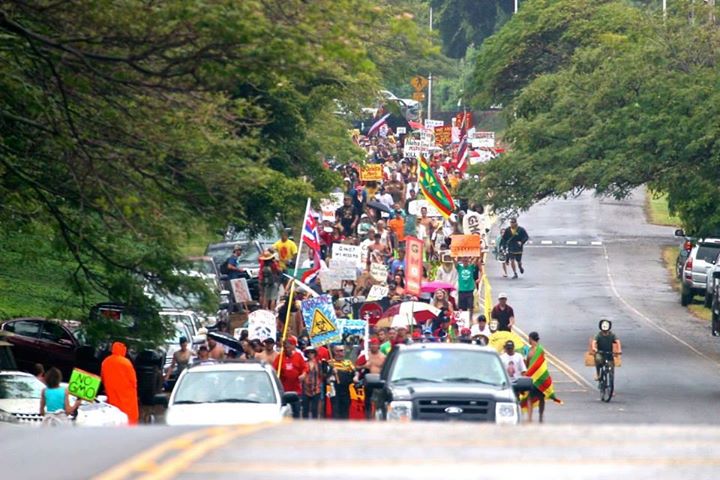
If you have spent a minute on the social media, you would have heard that tomorrow is another March Against Monsanto in Waikiki and worldwide.  Many misguided folks will be getting ready today for that planned march against this so called “evil.”  The Babes Against Biotech are planning a flash mob and busy choreographing something during this social event to protest this perceived enemy.

Meanwhile, there are people in this world who still go without food.  That includes many people here in Hawaii.  The homeless, elderly, poor and others await to get their food from the local IHS, Meals on Wheels volunteer, or the Hawaii Foodbank.  The needy folks look forward to a hot meal over an empty stomach any day and don’t turn their noses up in disgust over what it could be.  What hungry person ever turned away a good meal? Many volunteers will be serving the these people food marching up and down kitchens or sidewalks to get to a hungry recipient.  Others maybe organizing bags of donated food to be handed out to a family, who doesn’t pull out the items and scrutinizes every label or fret about pesticides.

The farmers will also be working on this weekend preparing for next week’s crops and getting their fields planted too.  There is no time to stop and learn a dance, print flyers, paint signs and gather up a costume for an event like this.  Growing food is a never ending cycle that requires lots of time and effort to come to fruition.  Time is valuable to them to do the work they do year after year.  Their marching will be to the tractor in their shed to get it ready to plow or down the field to check the irrigation lines.

So while it is proclaimed across the social media that there is a March Against Monsanto once again, the real people who care about others will be busy at their tasks.  Good will and good intentions will be far more reaching that a march could ever do.

A Day on Papa’s Farm

DSC_1292

From the time my siblings and I could follow directions, we were working on the farm.  Our Saturdays were spent on the farm working.  We did get to play here and there while waiting for the harvested fruit to come in from the fields.  Those were some fun and great memories.  The memory that sticks in my head is

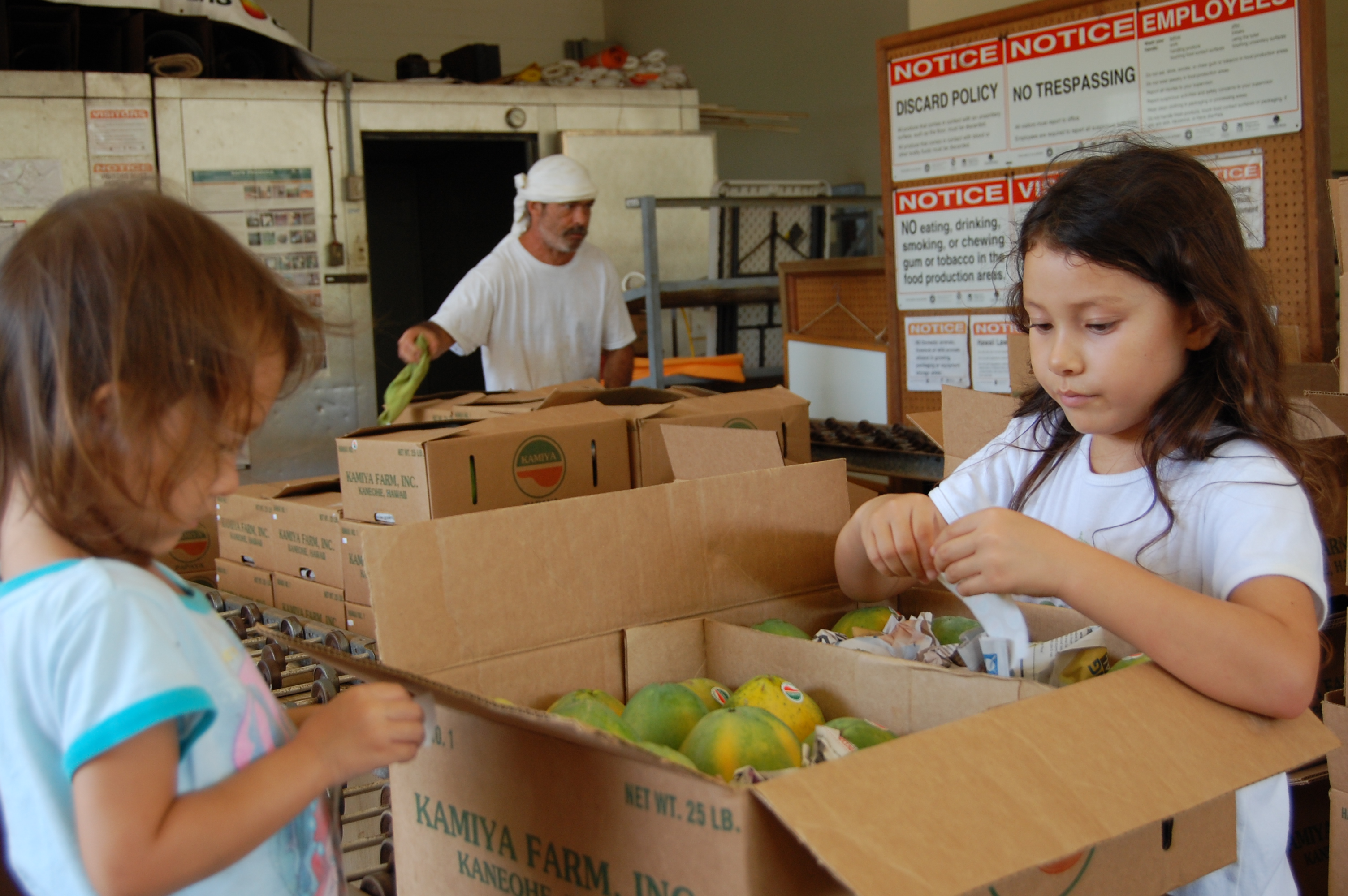
My mom reminded me that at 3 years old, my youngest sister was already stickering the papayas.  As an 8 year old, I was one of the washers who cleaned the fruit before packing.  From there I moved on to grading the fruit to some packing.  It was hard work!

I want my kids to experience that too so we headed down to the farm today.  I already warned them that we were going down there to work and not just play.  My older daughter agreed to it since she found out that she could collect recyclables and make some money afterwards.

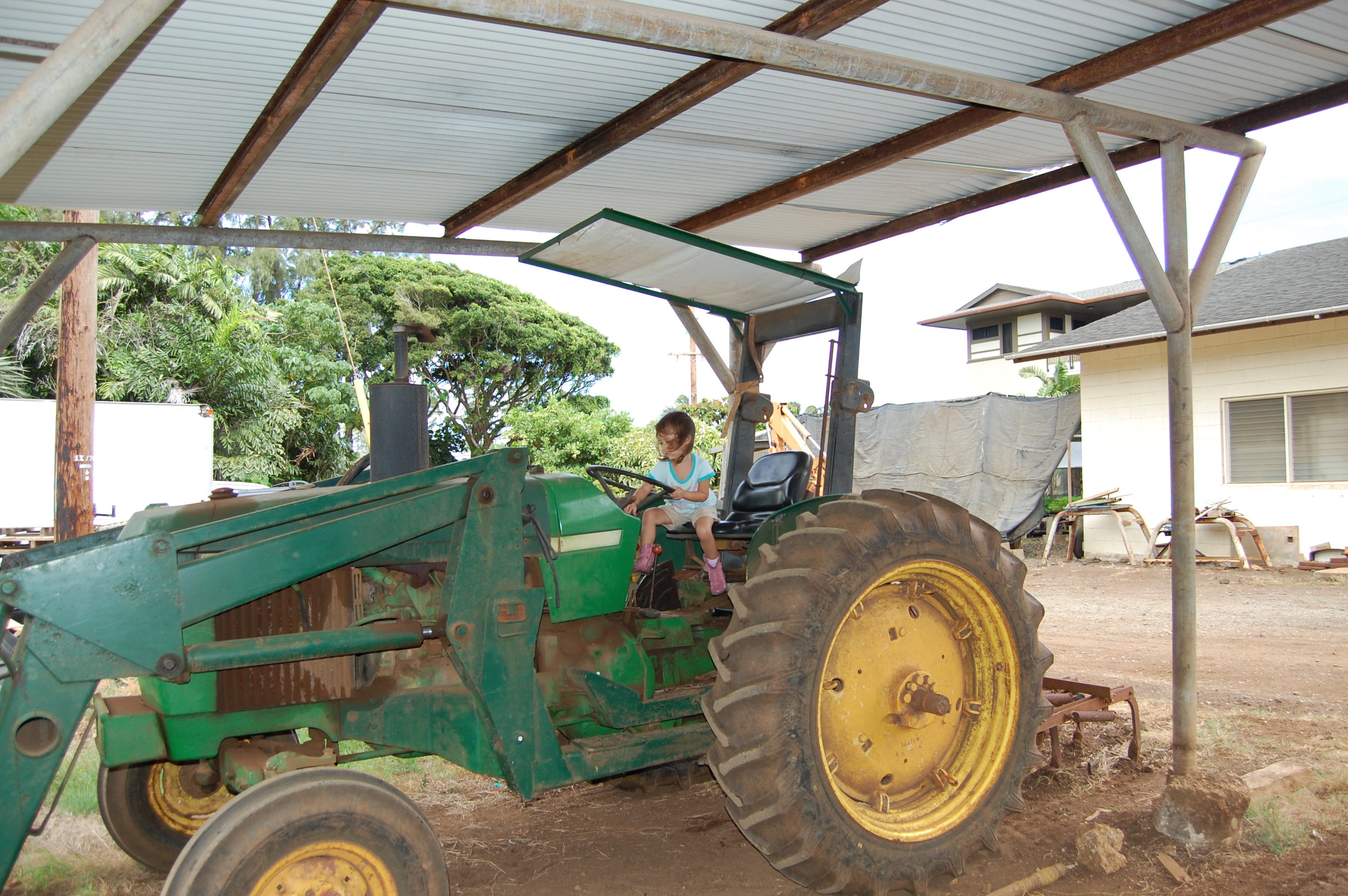
Today started out with my younger one, KK in awe of all the tractors everywhere on the farm.  She saw some at the sales lot a few days ago and kept telling my dad that she wants to ride one.  Just look at her face and see the thrill of just sitting on one.

DSC_1336

KK getting to hang out on one of papa’s tractors. She’s my dirty little farm girl kid.

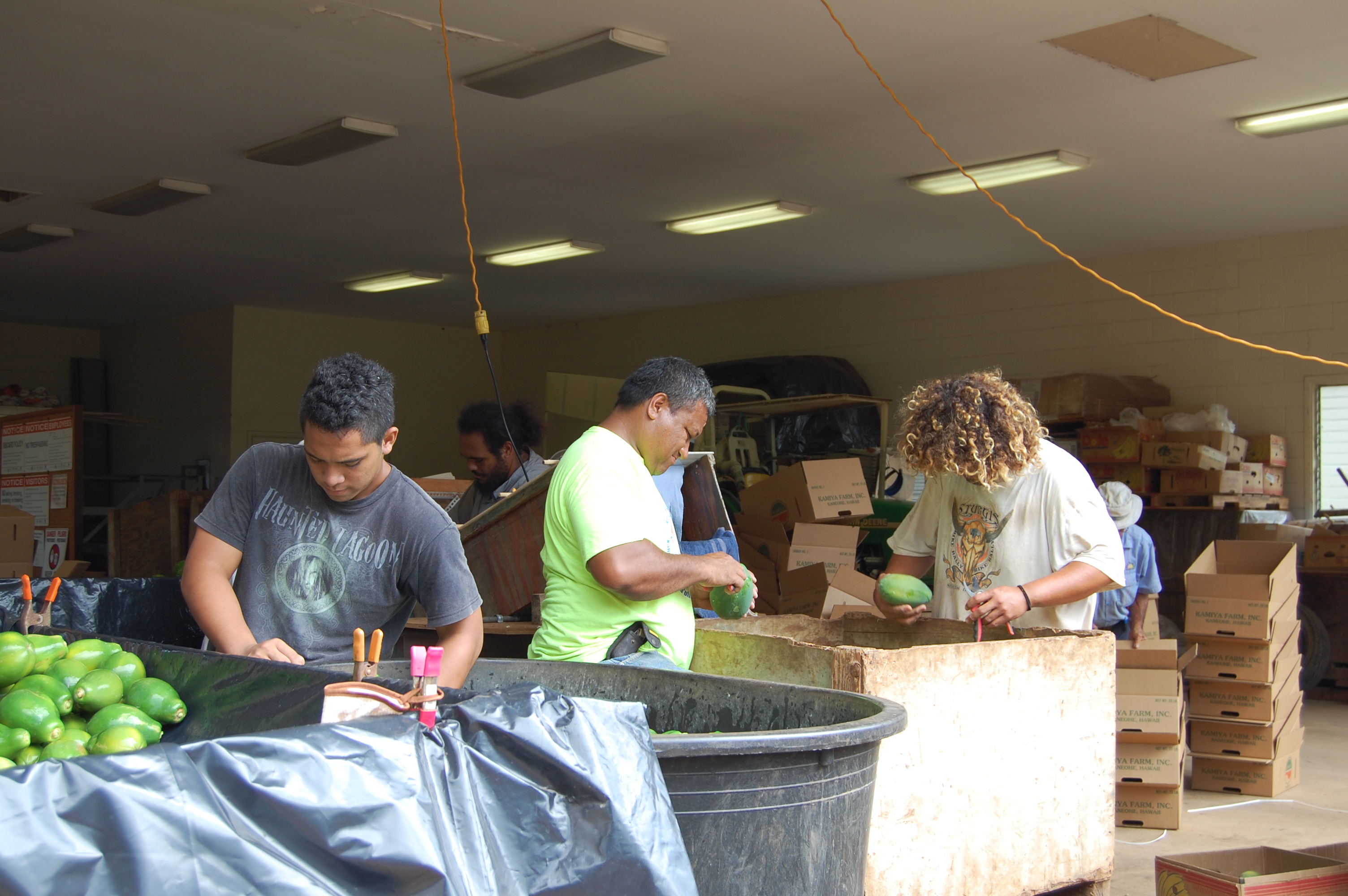
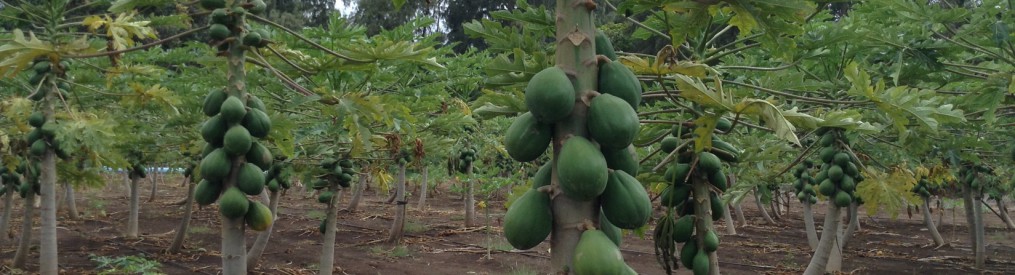
While the fruit was being picked in the fields by my dad’s hard working staff, we were preparing for the packing and processing.  Harvesting is done by a forklift as the trees do get pretty tall and this is a much more efficient way to get the work done.

Processing the fruit takes a lot of prep work.  That included taping up boxes to pack in, setting up the bins and wash tub to clean the fruit in and setting up the sorting area as well as the final storage area after it was packed up.  Our farm complies with all of the food safety certifications and follows the rules very closely with washing the fruit properly as well as handling it as approved.  We are food safety certified with a perfect passing score according to my brother, Mike.

DSC_1295

The hard working staff processing the fruit by grading it, washing it, and sorting it.

After it is prepared, the fruit is then packed up according to size which takes some skill as to packing them properly.

DSC_1323

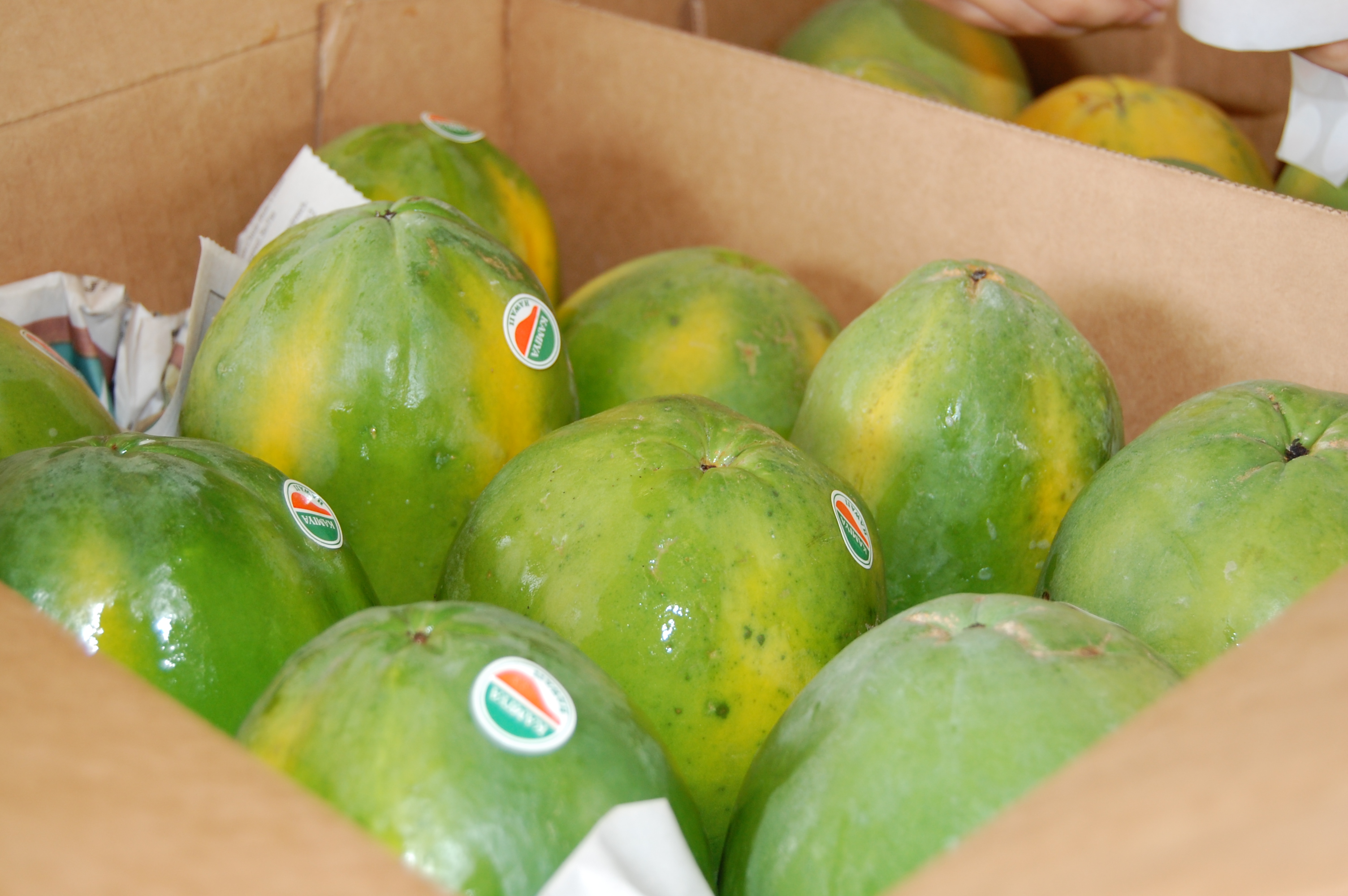
Finally after being packed, these fruits are stickered and palleted.

DSC_1305

KK and Ky hard at work putting those exclusive Kamiya Papaya stickers on the fruits.

Tomorrow it will be ready to go out to the stores, restaurants, small markets, and hotels to be sold or served up to their customers.  Many of whom come clamoring for it every week for years!

DSC_1247

Tokyo Rose and the “Antagonizing” of Bryna Storch

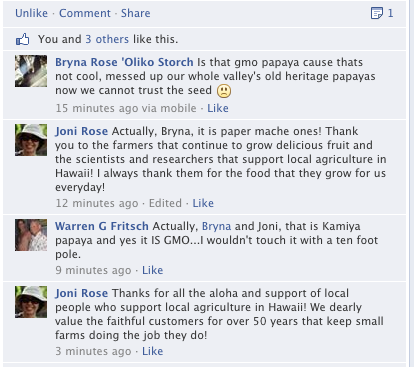
`Ever since the Kanu Hawaii post on papaya several months ago, I had the opportunity of some commenter named Bryna Oliko Storch accusing me of various things.  Kanu had a really ill informed post up on their Facebook page (which is no longer posted, thank goodness!) about where to find non-GMO papayas.  I really despised how the wording was put on the post as if to imply that non-GMO is better than the disease resistant variety when the evidence shows that there is little to no difference.  Of course all the anti-GMO commenters decided to have a field day on there including Bryna Storch, who I encountered there first.

Kanu is a public page that had been leaning toward the anti-GMO side which I was very disappointed in.  When I saw this post on the Kanu Facebook page, I was immediately turned off.

antievent

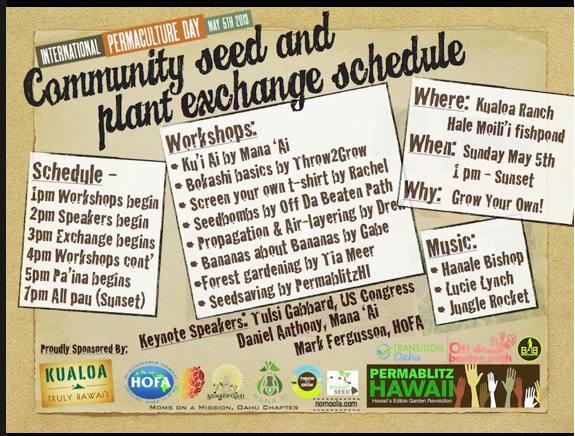
There was posts on there for the anti-GMO event disguised as a “green” event sponsored by many of the same groups and Tulsi and Mike Gabbard, Hawaii Organic Farming Association, Hawaii SEED, and others.  (You can read some of my other posts linking the Gabbards to the Babes Against Biotech and some of the nasty comments made by Daniel Anthony about drinking RoundUp to people who speak out about farming.)

I decided to quit Kanu as a member for their unbalanced view of agriculture and the issues around seeing that event posted.  I stayed away from it all and checked back several months later to see if anything had changed.  I was not wrong because sure enough there was a post on papayas filled with the most ignorant and idiotic comments I have ever seen! (Those posts are removed from the page from the last few times I have checked the page.)

keone1 frest1dumbcomments

Of course Bryna starts up again on her issues with papaya that shows her knowledge about the ringspot virus to begin with, none.

kanu

She apparently thinks that the virus came from Mexico which is completely false and she doesn’t even know how it is spread.  If you do research, you’ll find that it originated in a completely different country.  Her prior comment shows that she has the same idea of “contamination” in her head which nearly all anti-GMO folks will claim.  A simple Google search disseminating the propaganda and targeting info from legitimate sites will tell one a lot about the history of papaya and the ring spot virus.

According to Wikipedia with resources cited:

“Using genetic phylogeny studies, researchers suspect the virus originated in Asia, likely India, about 2,250 years ago. From there it slowly spread through the continent reaching China about 600 years ago. It was also introduced directly from India to Australia and the Americas within the last 300 years. Papayas were introduced to India only 500 years ago, at which point the virus made the jump from cucurbits. However, the virus has switched back and forth between pathotypes many times in its evolution.”

Bryna is dead wrong about where it came from.  And as for the transmission of the virus, the info shows that the vector is from aphids from the same referenced entry in Wikipedia.  She claims she’s a farmer yet doesn’t even know this?  What’s up with that?

I find it very hard to believe that Bryna has been farming papaya for 40 years and doesn’t even know the basic facts on the virus history.  However, what she does say, will only spread more misinformation about the issue even further, which is what prompted me to comment on the Kanu post to begin with.  I emailed the executive director about the issues I had with the post and sent tons of links and resources to back up my statements too.

So several months later, I got to encounter Bryna yet again on the 4AgHawaii Partnerships when my nephew’s photo in his papaya costume was posted right after the Hawaii Farm Bureau Farm Fair.  There were two anti-GMO commenters on there making comments and I had to say something.

storch

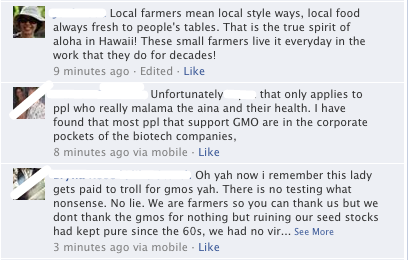
I took the snarky approach to Bryna and her crony didn’t like it and chimed in.  Some people just don’t have any sense of humor or even think about who and what they are commenting about too, which I find distasteful in so many ways. After my last comment she makes this statement to me:

ignorant warren bryna

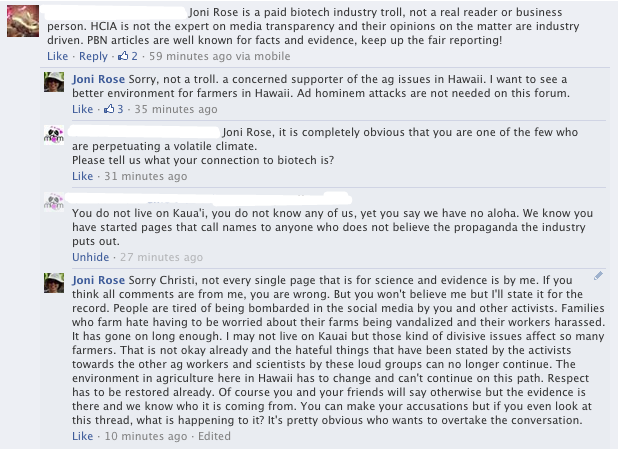
Now how is it that once can go to an open page that doesn’t take any sides to the biotech issue be considered a troll?  Who knows.  All I know is that the tactic is played when one has no other evidence to support their stance and it is the last thing they can do in a public forum as such.  It’s weak and just like what kids do when you get called a “booger head” at the end of a confrontation.

Well, no sooner did I realize that Bryna is REALLY watching what I say.  When Pacific Business News came out with a question for the editorial board about Bill 2491, several pro-biotech comments were made and the anti-GMO mob of course did what they do best, is mob the social media as always.  So when I simply posted my question that I would like to ask the board this is what ensued.

bstorch3

And I mustn’t leave out Bryna’s lovely comment to me yet again.  That’s when the word was out about my new nickname!  I actually knew about it because someone had already emailed me about it several weeks prior.

bstorch4

bstroch5

When you got nothing in the form of evidence to back up your statement, attack them personally, for that is the way of the A’ole GMO mob here in Hawaii!

(This may bother some folks to read this, but honestly, it doesn’t bother me at all because it just shows the level of maturity and intelligence that they people lack at all angles about the entire agriculture issue in Hawaii.  For every statement and derogatory comment directly made at those speaking out for agriculture in Hawaii, you should be held accountable for it!)

Tulsi Gabbard does not Care about All Farmers

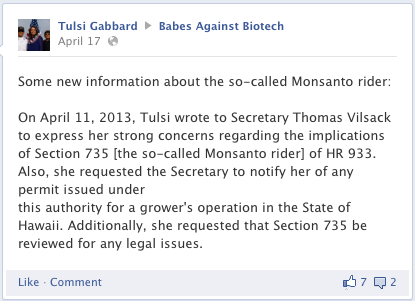
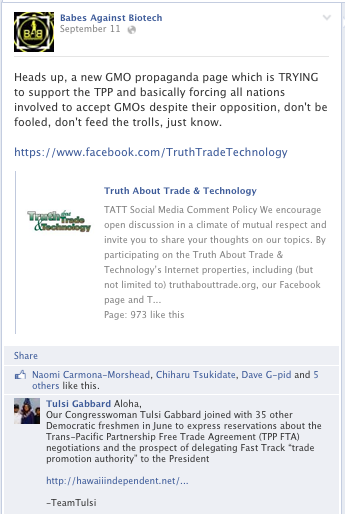
As a voting constituent, I feel that I have a right to voice my opinion to my Congressional Representative, Tulsi Gabbard.  I have noticed how she’s been posting lots of things with the Babes Against Biotech pages from months ago.  (She apparently drinks from the same punchbowl as the anti-GMO mob all do when she starts using the terms Monsanto Protection Act.)

BAB Gabbard link Gabbard and babs

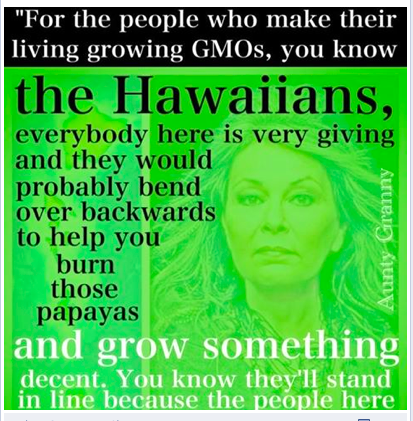
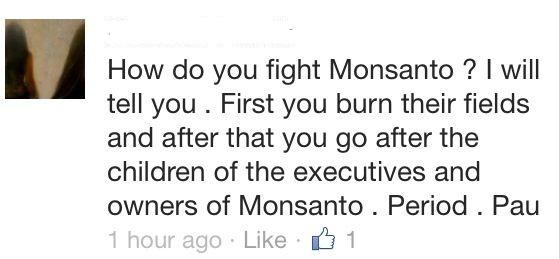
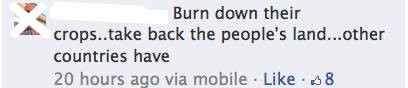
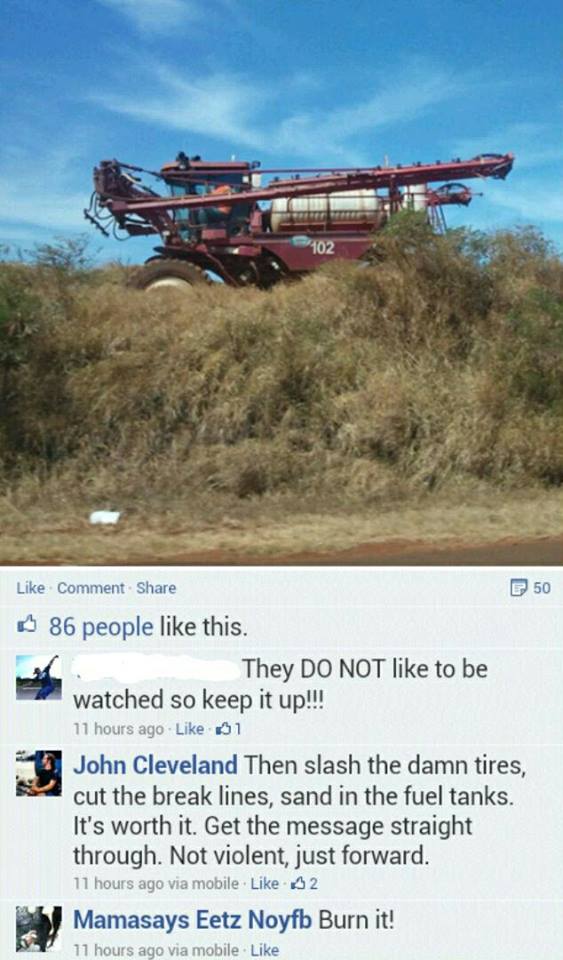
Honestly, I was shocked to see that this representative was okay with being associated with activists that endorse crop destruction.

babs crop destruction

So, I decided to no longer be quiet about this at all because I have seen and felt so much hate and ugliness being directed towards farmers here locally.  That is not okay with me at all.  How can such a representative of the “people” avoid all the evidence presented?  Is it ignorance like what the anti-GMO mob clings on to or what is it?  I decided to give her the benefit of the doubt and simply voice my opinion of the issue to her.

Screen shot 2013-10-02 at 9.33.55 PM

This is the response I got back from her:

Screen shot 2013-10-02 at 9.38.21 PMOkay, so she visited one farm and went to this anti-GMO event:

antievent

So I pressed her a little more:

Screen shot 2013-10-02 at 9.42.44 PM

Others jumped into the thread too with these comments:

Screen shot 2013-10-02 at 9.45.21 PM

Her team’s response to me was that I should contact her about visiting the papaya farm.  Which I immediately did that day.

Screen shot 2013-10-02 at 9.44.59 PM

Well, that was several months ago and our farm has yet to hear a peep from our representative regarding this issue.  That tells us farming families a lot about who she’s listening to and it’s not us.

I went back to her page to attempt to post something and lo and behold, I discovered this!

Screen shot 2013-10-01 at 11.10.53 PM

When you get this kind of post that only allows you to “share,” you know you’ve been banned.  We know who she’s really looking out for now.  It’s her Babes Against Biotech anti-GMO mob and not certain farmers in our islands.  Ignorance not only runs in the general public but also in our own congressional representative.

So Team Tulsi and Tulsi Gabbard, if you should find my page, I am all about getting educated.  Please take the time to learn about biotechnology through some simple videos like this one.  The world needs more research and science, not the perpetuation of ignorance and fear that you support with your stance.

An Open Letter to Hawaii Politicians about Agricultural Technology

Dear Governor, Legislators, Senators, Representatives, County Council Members, City Council Members,

I am writing to you as a daughter of a long time farmer, Kenneth Kamiya.  Our family has been long time farmers for over 4 decades on the Windward side on Oahu.  My grandfather farmed the land with beans, Okinawan potatoes, cucumbers and finally papaya, which my dad and brother continue to this day.  I am asking for your support in these contentious times of dealing with the issue of agricultural technology, specifically GMOs.

The First Kamiya Farmers

I speak out not only for our family but for all other families in our islands who use this technology to run the farms that they do.  Our state cannot afford to be left behind because of the maligned fears of the public of this technology.  You as a leader also have to be able to separate fears created by the black marketing strategies and consider the evidence that is presented.  That is your responsibility to us as your constituents, even though the farmers and ranchers make up 1-2% of the public.  Those are the voices that should ring loud and clear in your minds.

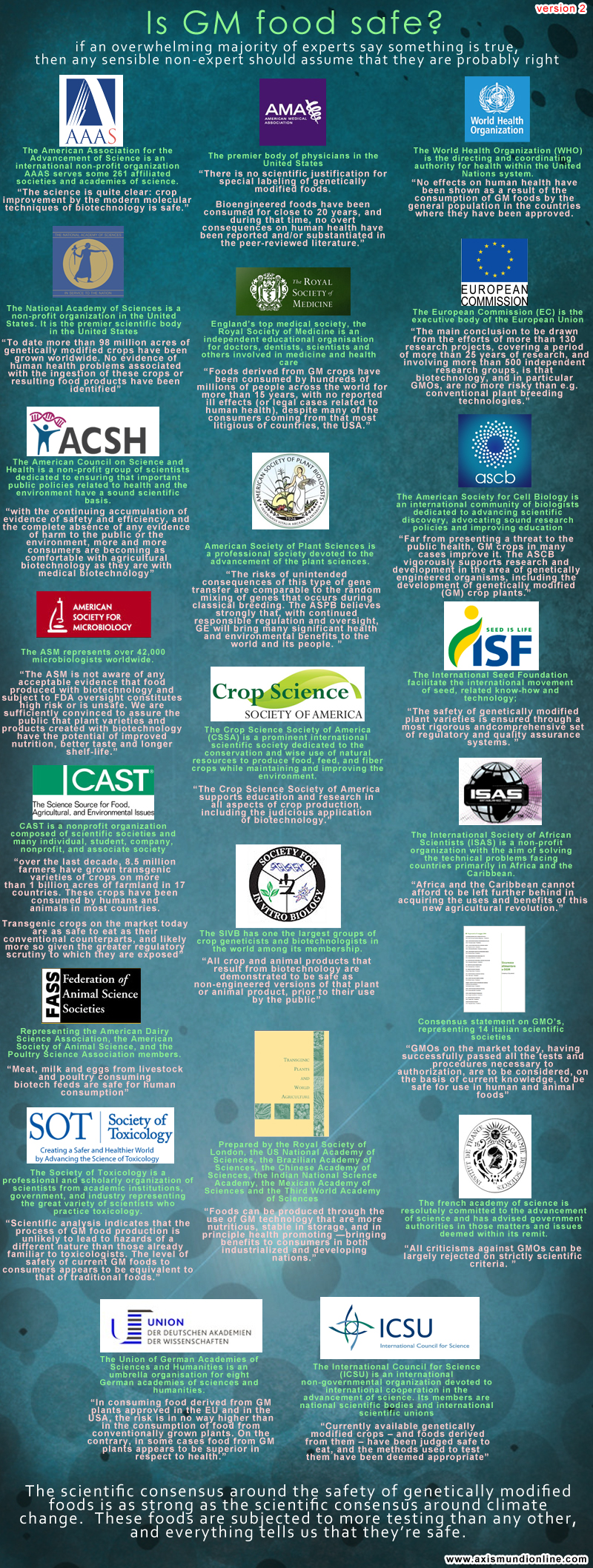
What does the evidence show us?  Worldwide, there is a consensus that biotechnology is safe.  Read below for the worldwide organizations that have made statements about biotechnology in food:

GMAuthoritiesnew1

Given this evidence, will you accept what the worldwide scientific community states?  Or will you fall prey to the fear mongering of the environmentalists and the organic industry’s tactics like this:

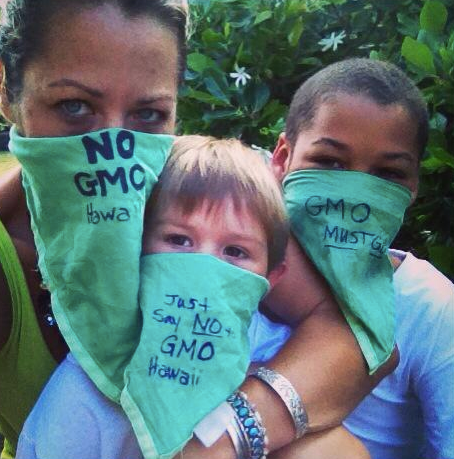
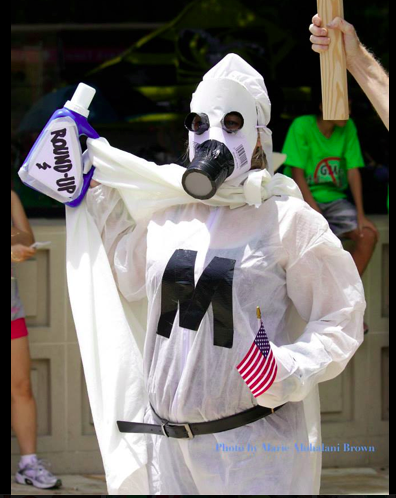
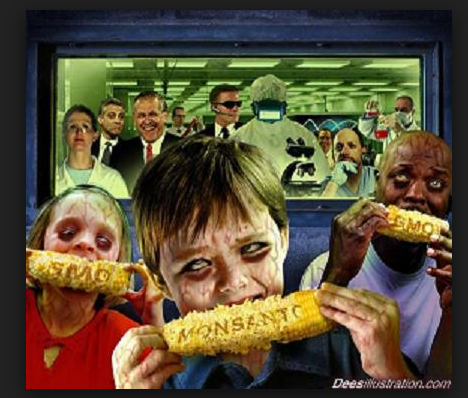
facemaskScreen shot 2013-06-29 at 9.45.24 PMscaremongering

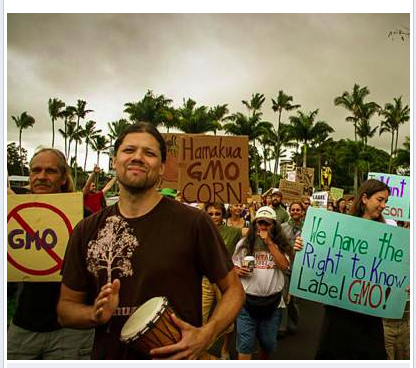
The public sure has become beleaguered with fear which is evident when you see these kind of events happening across our islands:

Screen shot 2013-06-29 at 6.04.11 PM protest

The same people that join in these protests are so fear mongered that they have even done this to farmers or anyone who speaks out for biotechnology:

KB crop destructor  DF fertilizer momi LM

ly

namastestpeh MV RGV tw2 tw TC manaai agroterrorism

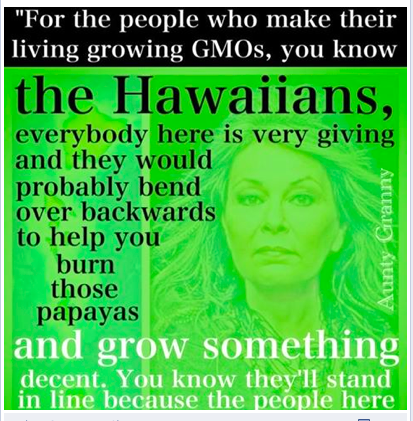
Activist groups too are guilty of promoting hate and crop destruction as in this meme from the Babes Against Biotech with Roseanne Barr’s quote:

babs crop destruction

Notice how much hate there is because fear has made many people irrational already.  Ignorance is evident here in many of these comments.  And it’s not pretty to be at the receiving end of it.

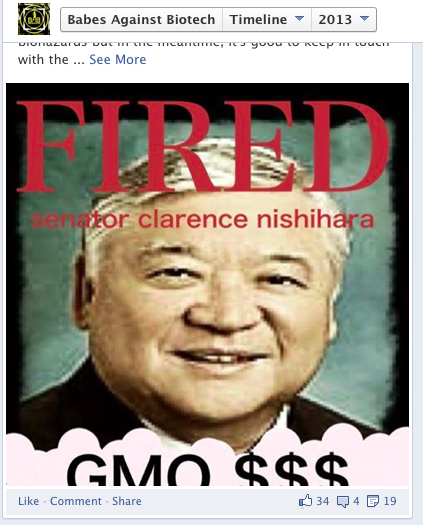
We know that many of you have become the receiving end of these activists, especially the Babes Against Biotech who went after Senator Nishihara last year.  We know that many of you have also been portrayed as targets too.

nishihara target

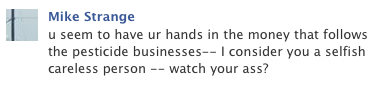
As a result, not many people want to speak out for agricultural technology here and when you do, many times, you get threats like this sent to you.  Here’s one I personally received a few days ago:

Screen shot 2013-09-28 at 2.49.19 PMmike strange

Or you might get called a name or something, but it doesn’t bother me for I know what the truth is:

tokyo rose

So when leaders like you decide to reject the evidence presented, you are feeding and fueling fear.  This same fear happens because so many people have little to no knowledge about agriculture or the technology around it.  They may be loud and demanding but you must also listen to the quiet ones who toil in the fields every day.  My family like so many others are just regular people who want to have access to the tools to do the job we have at hand, which is to feed people the best way possible.

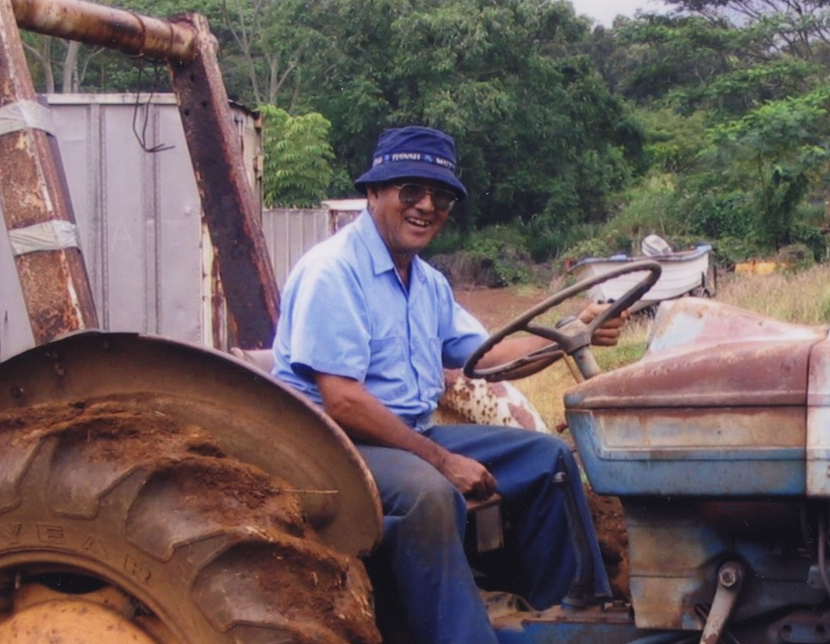
Kenneth Kamiya, my dad Kenneth Kamiya, my dad

When it comes time to listening to your constituents, all I ask is that you listen to your most valuable ones.  The farmers!

Aloha,

Joni Rose

The Hawaii Farmer’s Daughter

What can a Farmer do?

Kenneth Kamiya, my dad

Kenneth Kamiya, my dad

Growing up as a kid and having to work on the farm, it is easy to not appreciate the things you have until you’re older.  As a kid, I hated having to wake up early on the weekends to go down to the farm.  We never had the chance to lounge around watch cartoons in the mornings.  I used to think that this was so unfair that we were the only kids who couldn’t do this.  It was like drudgery every weekend to know that we were the workers.  From the time I was about 8 until I was well into my twenties, it was working on the farm at least once a week.  Even during the summers it was working for me and my siblings.  The work got easier when we realized that we could negotiate being paid.

My parents always taught us that if we ever wanted something, we had to earn it fair and square.  You couldn’t make deals with them if you wanted that new cassette tape of Wham! or Madonna.  If you wanted it, you had to work.  There was no other option to them.  We did learn that grandma and grandpa were great ways to just get things easer though.

Well, you can bet that as a teenager, when I had the first opportunity to get a job elsewhere, they were all for it.  It felt great to not be working in the fields, or in the shed processing papayas for hours.  To scoop ice cream in an air conditioned mall and decorate cakes was fun!  The work was way easier than the farm any day.  I was happy to be free as teen and later as a college kid.

As I step back, my views of the farm have changed now that I have children.  I realize that as much as I hated working on the farm, I truly had the best childhood growing up and an amazing farmer father.  He was a tough guy as a dad and very strict but the lessons I learned stick with me to this day.  He may have officially retired from his regular job, but he still works more than 40 hours a week doing what he loves the most:  farming and agriculture.  His family always comes first but those are his other true passions in life.

His own early lessons in life helped to build his values to what they are.  My dad grew up very poor.  His dad was a dairyman and farmer himself.  He spent his childhood playing around in the dump searching for handy reusable trinkets or other recyclables.  His way of recycling would put the modern day green person to shame.  They reused everything and saved many things.  He has some of the same tools that his father used on the farm that is still usable to this day, some 60 years later.  Talk about durable!

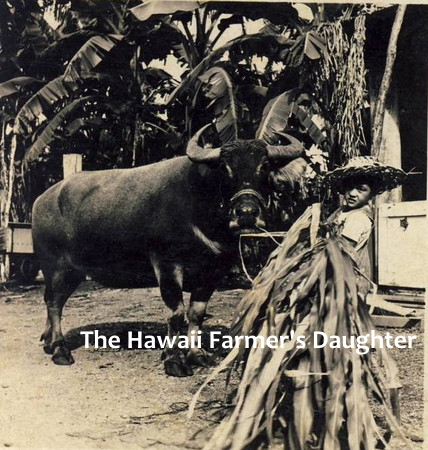
dadwaterbull-Mw

As a farmer’s kid himself, at a young age, he learned the ropes of how to do everything.  He could ride a water buffalo to use it to plow fields, tie knots of every kind, drive any vehicle, and fix it too.  He was always tinkering. Later when he realized that the military could give him an education and other skills that also shaped his life.  Soon he was in Vietnam fixing aircraft in the Air Force also.  Those experiences gave him the skills to do practically anything, which he indeed does.

My dad is unbelievably skilled at nearly everything which is no understatement.  He rigged up his own tractor to become a forklift, welded the picking platform, built bins, built the shed and processing portions, plows, drives a backhoe to dig up stuff or uses a bulldozer to grade the land, can diagnose plant pests and diseases, knows how much and when to fertilize the fields, lays out drip lines and irrigation systems, knows which cover crops to grow and when to plow them in, delivers and packs the fruits and can instantly spot a ripe one from 10 feet below, hauls 50 lb. boxes of fruit several hours a day, knows how to control any weed and what to treat it with, knows almost every kind of plant there is to know and how to grow it, can reuse old fence posts to build a new fence, fix big rigs and trailers as well as park those things, can maneuver in the tightest of spots in Chinatown when delivering the fruits, and so many more skills that I could not list.

Farmers like my dad and others across the world are truly amazing people.  Until you know one personally and see exactly what they do and how they do it year after year, you can appreciate the depth and dedication that these people live and breathe each day.  Farmers were considered one of the noblest of professions which should still indeed ring true today.

In the words of Thomas Jefferson:

“Agriculture is our wisest pursuit, because it will in the end contribute most to real wealth, good morals, and happiness.”